

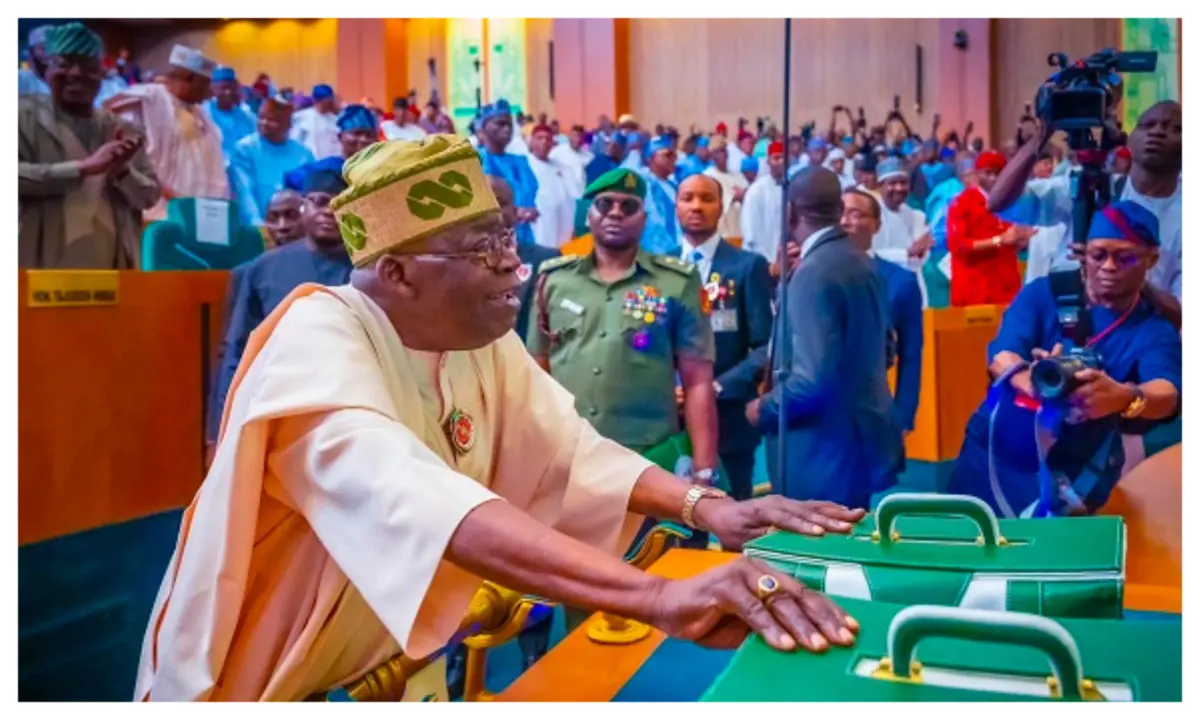
President Bola Ahmed Tinubu’s N49.7 trillion 2025 budget proposal, presented to the National Assembly on Wednesday, has sparked a range of reactions from economists and analysts, with both praise and criticism following its release. The proposed budget marks a significant increase from the N30.94 trillion presented in 2024.
A closer look at the budget shows substantial allocations for key sectors, including Defence & Security (N4.91 trillion), Infrastructure (N4.06 trillion), Education (N3.52 trillion), and Health (N2.48 trillion). These priorities are seen as addressing the country’s critical challenges, with the president projecting a GDP growth rate of 4.6%, inflation reduction to 15.75%, and an exchange rate of N1,500 per dollar. The budget also anticipates a revenue target of N36.36 trillion and a deficit of N13.39 trillion.
Economists have weighed in with both support and caution. Muda Yusuf, CEO of the Centre for the Promotion of Private Enterprise, praised the budget’s focus on Defence, Infrastructure, Health, and Education, considering Nigeria’s current socio-economic situation. He emphasized that the president’s assumptions—such as reduced fuel imports, increased agricultural output, and improved foreign exchange inflows—are achievable with proper implementation. However, Yusuf also raised concerns about the N15 trillion allocated for debt service and the ambitious revenue projections, which could result in higher taxes or fees, placing additional pressure on investors.
Prof. Godwin Oyedokun, a university professor, criticized key assumptions in the budget, particularly the projected exchange rate of N1,500 per dollar, which he deemed unrealistic given the current parallel market rates. He also questioned the $75 per barrel crude oil price benchmark, calling it overly optimistic amid global oil market volatility and environmental shifts. Oyedokun noted that the target oil production of 2.06 million barrels per day could face obstacles, including oil theft and infrastructure issues.
On the matter of security spending, Oyedokun acknowledged the need for defense funding due to the nation’s security challenges but raised concerns about balancing defense priorities with human development. He also warned that the healthcare deficit in the budget could exacerbate existing challenges in the healthcare sector, despite the planned infrastructure investments.
Bismark Rewane, CEO of Financial Derivatives, remained optimistic about the potential impact of the budget, suggesting it could lead to improvements in 2025 if properly executed.
While the budget aims to address Nigeria’s long-standing issues, experts stress the importance of adjusting unrealistic assumptions, diversifying revenue sources, improving tax collection, and investing in human capital and sustainable development to ensure long-term economic stability.


