

By Qiang Wei, People’s Daily
As geopolitical tensions escalate in the Middle East, oil prices are unlikely to return to pre-conflict levels in the short term.
Around the world, countries are grappling with rising energy bills. In some places, prices are surging; in others, large-scale power cuts and rationing have become unavoidable.
Against this backdrop, international observers note that China appears comparatively composed. This resilience is attributed not only to its robust energy reserves and diversified supply chains but also to years of steadfast progress in green energy transition. The widespread adoption of electric vehicles, in particular, has strengthened the country’s ability to withstand external shocks.
While no nation remains untouched by conflict and crisis — Chinese consumers, too, face higher fuel prices — China’s relative stability stands out. Government interventions have played a key role: to mitigate the impact of rising global oil prices, China implemented refined oil price adjustments. For instance, on April 7, planned increases of 800 yuan ($117.12) and 770 yuan per ton for gasoline and diesel, respectively, were capped at 420 yuan and 400 yuan.
Some commentators, however, misinterpret China’s composure as evidence of “benefiting” from the conflict. Such cynical narratives reflect a fundamental misunderstanding of China’s long-term commitment to energy transition and its tangible achievements in this field.
China’s stability is rooted in its commitment to high-quality development. As the world’s largest importer of crude oil, given its vast economic size and sustained growth, China is well aware that true energy security does not lie in how much oil it can purchase or from whom, but in reducing reliance on oil altogether.
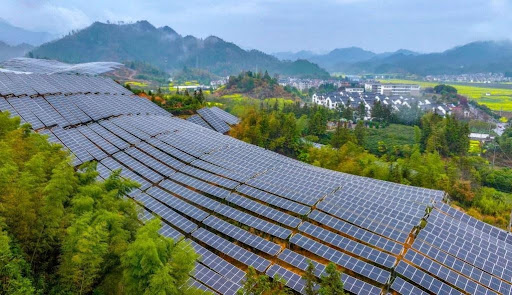
China has ranked first globally in installed wind power capacity for 15 consecutive years and in solar power capacity for 10 years. Its power battery production accounts for more than 60 percent of the global total. By the end of 2025, China had 43.97 million new energy vehicles in use, accounting for 12.01 percent of the country’s total vehicle fleet.
Besides, charging and battery-swapping infrastructure now extends across both urban and rural areas, while continuous breakthroughs are being made in battery and charging technologies. In this way, China has forged a distinctive path of energy transition.
China’s composure also stems from its deep integration into the global economy. China’s development has never been inward-looking. Chinese-built photovoltaic projects have brought light to households across Pakistan; Chinese electric vehicles have become a new sight on the streets of Southeast Asian countries; and China-supported geothermal power projects are delivering clean energy deep into the African continent. By promoting inclusive global energy development, China is helping make green electricity not a “luxury” reserved for developed countries, but an accessible option for all.
China’s composure further reflects its firm commitment to implementing the Paris Agreement. Under its “dual carbon” goals of peaking carbon dioxide emissions before 2030 and achieving carbon neutrality before 2060, the share of non-fossil energy in China’s total energy consumption continues to rise, while carbon dioxide emissions per unit of GDP keep declining. The outline of the 15th Five-Year Plan has incorporated the share of non-fossil energy in total energy consumption as a key indicator of economic and social development.
Last year, China formally submitted its 2035 Nationally Determined Contribution to the United Nations Framework Convention on Climate Change secretariat, clearly outlining its ambition and concrete measures to advance green and low-carbon development.
At the recent China Development Forum 2026, Han Wenxiu, executive deputy director of the Office of the Central Committee for Financial and Economic Affairs, shared a key insight drawn from the current international situation: fossil fuels such as oil and gas often rely on imports and international transportation, whereas renewable energy sources like wind and solar are locally available and require neither.
This view may sound simple, but it is grounded in China’s real-world experience and offers food for thought for the rest of the world. China’s composure is not a matter of luck, but of foresight; not accidental, but inevitable. With green development as its defining feature, China will continue to translate this composure into a steadfast pursuit of a global energy landscape that is fair, inclusive, clean, and sustainable.


