

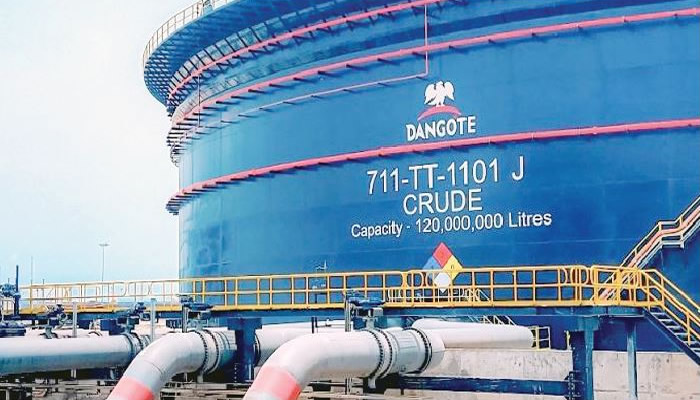
The Petroleum and Natural Gas Senior Staff Association of Nigeria (PENGASSAN) has called on the Federal Government to increase its shareholding in the Dangote Petroleum Refinery from the current seven percent to at least 45 percent. This move is aimed at ensuring energy security and stability for Nigerian citizens.
During a presentation in Lagos, PENGASSAN President Festus Osifo emphasized that a larger stake in the refinery would bolster energy security, which he deemed essential for national survival. He stated, “Energy security is cardinal for the survival of any nation, and Nigeria is no exception. Citizens demand energy affordability, accessibility, and availability.”
Osifo also recommended that the government collaborate with private sector players to maintain existing petroleum product storage facilities across Nigeria’s six geopolitical zones. “Operational petroleum product storage will be crucial during supply shortages, helping to alleviate the recurring fuel queues at petrol stations due to poor road conditions and severe erosion,” he noted.
He stressed the need to expand pipeline infrastructure to facilitate the distribution of refined products nationwide, reducing reliance on trucks that contribute to road congestion.
Highlighting the importance of affordability in energy production, Osifo urged the government to stabilize the naira, asserting that the currency’s continuous depreciation directly affects the cost of petroleum products. “If the exchange rate was N450 to a dollar, PMS would be around N320 or N350 per litre. The real issue is the devaluation of the naira,” he explained.
Osifo advocated for the government to revitalize Nigeria’s four refineries and suggested that once operational, it should divest majority shareholdings, retaining no more than 49 percent. He revealed that despite the Nigerian National Petroleum Corporation (NNPC) only managing a 7.2 percent stake in the $20 billion refinery, Dangote was previously open to selling a 20 percent stake.
He expressed concern over the implications of the naira’s devaluation, which he believes has made Premium Motor Spirit (PMS) unaffordable for many Nigerians. He urged the government to develop a robust oil and gas value chain to enhance the distribution system and mitigate fuel shortages, often exacerbated by a truck-based logistics system vulnerable to disruptions.
PENGASSAN also addressed the recent trend of divestment by international oil companies, calling for a strategic shift toward local empowerment and talent utilization. They highlighted the potential risks and opportunities presented by these divestments, such as reduced foreign investment and technical expertise, along with a possible decline in production levels.
The association recommended a comprehensive divestment framework under the Petroleum Industry Act (PIA) to guide asset divestments in the Nigerian upstream petroleum sector. They also called for measures to protect jobs amid these changes, advocating for a Memorandum of Understanding (MOU) between divesting companies and trade unions to safeguard employment and enhance workers’ welfare.


