

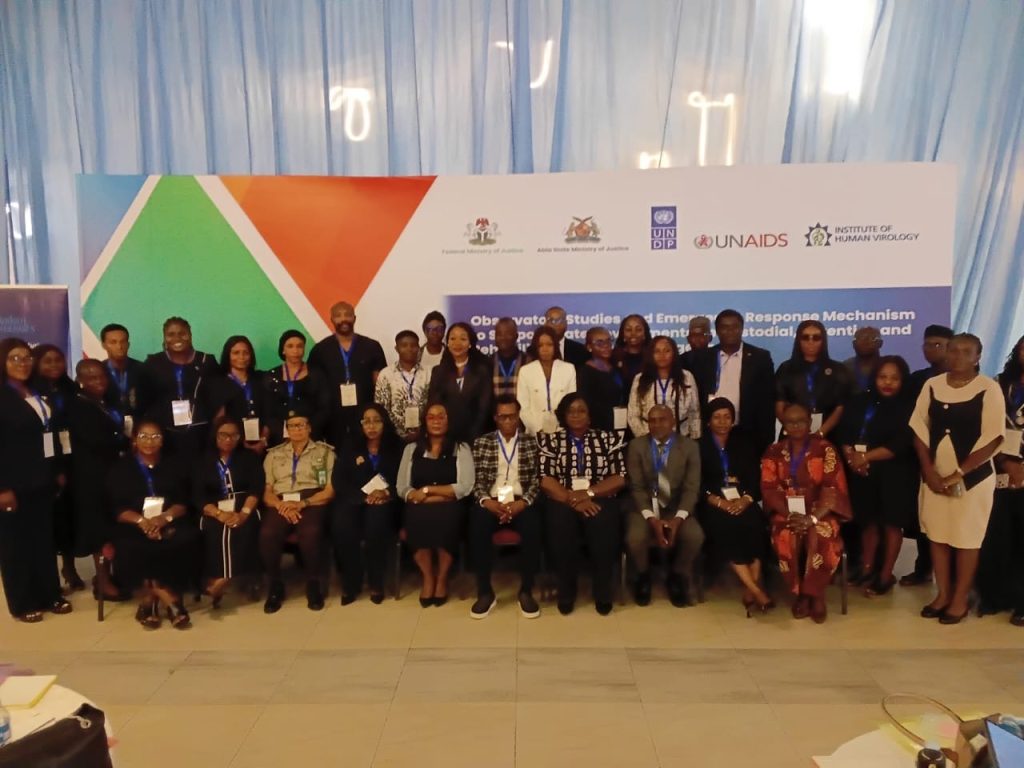
The United Nations Development Programme (UNDP) has expanded the geographical coverage of its High-Level Observatory on HIV and Infectious Diseases in Custodial Centres from 12 states to 19 states and the Federal Capital Territory (FCT), bringing the number of participating jurisdictions to 20.
The expansion is aimed at strengthening evidence-based interventions, institutional accountability and the protection of human rights and access to healthcare in Nigeria’s custodial centres.
The UNDP Nigeria Programme Lead, Gender, Justice, Human Rights and Health, Mrs Onyinye Belinda, disclosed this at the opening of a data collection training for the Observatory in Abuja.
Belinda, who spoke on behalf of the UNDP Resident Representative, said the initiative would generate credible evidence to guide policy development, strengthen institutional performance and identify gaps in the implementation of laws and policies.
She described the Observatory as more than a data collection exercise, saying it was an investment in Nigeria’s capacity to understand the relationship between gender equality, justice, human rights and health governance.
According to her, the expansion would provide a stronger national evidence base for identifying regional patterns, comparing institutional experiences and developing recommendations relevant to national and state-level policies.
She said, “The ultimate value of the Observatory will not be determined by how much data we collect, but by how effectively that evidence is translated into decisions, reforms, investments and measurable results.”
Belinda urged participants to demonstrate methodological rigour, integrity, impartiality, confidentiality and gender responsiveness in carrying out the field exercise.
She stressed that the exercise was not intended to assign blame to institutions or individuals but to understand existing systems, identify gaps and generate evidence for improvement.
“The purpose of this exercise is not to assign blame to institutions or individuals. It is to understand systems, identify what is working, establish where gaps persist and generate constructive evidence for improvement,” she said.
Also speaking, the Head of the Sexual and Gender-Based Violence Response Unit, Federal Ministry of Justice, Mrs Yewande Gbola-Awopetu, said the Observatory was important in addressing the human rights and healthcare challenges confronting persons in custodial centres.
She said persons deprived of their liberty remained entitled to humane treatment, adequate healthcare, protection from discrimination and other safeguards guaranteed by law.
According to her, custodial status must never diminish the inherent dignity of inmates or exclude them from the protection of their fundamental rights.
Gbola-Awopetu said the quality of the Observatory’s findings would depend on the professionalism, methodology, ethical standards and procedures adopted during the field exercise.
She urged participants to ensure informed consent, confidentiality, privacy, sensitivity and accurate documentation throughout the data collection process.
“The pursuit of data must never take precedence over the rights and welfare of the individuals from whom that data is obtained,” she said.
She also called for sustained collaboration among the Ministry of Justice, the Nigerian Correctional Service, health institutions, development partners and other relevant stakeholders to ensure that the findings translated into practical improvements.
In his remarks, Professor Michael Kununji said the initiative was designed to generate credible evidence that would strengthen Nigeria’s criminal justice system and improve access to healthcare in custodial settings.
He said the study would provide baseline data to guide policy reforms and sustainable interventions, adding that the ultimate objective went beyond data collection.
“Ultimately, our objective goes beyond collecting data. We want to establish a rapid response mechanism that will ensure that when inmates are subjected to abuse or violations of their rights, there is a system capable of responding promptly and addressing such violations as they occur, rather than waiting until after the damage has been done,” he said.
Kununji also said the initiative envisaged establishing a high-level observatory that would serve as a watchdog, monitoring the criminal justice system and promoting fairness and accountability.
Similarly, the Director of Public Prosecutions in Imo State, Barrister Martins Udokwu, said the training had provided an opportunity for participating institutions to strengthen their capacity to address the healthcare needs and protect the rights of inmates.
Udokwu, who led a team from the Imo State Department of Public Prosecutions, said the state would work towards strengthening collaboration with correctional authorities and other relevant institutions.
He said the lessons from the training would be taken back to Imo State to improve documentation, case management and the protection of inmates’ rights.
“The fact that someone is in prison does not mean that the person no longer has rights. Inmates still have fundamental human rights, including the right to healthcare. They have the right to live, and their health and well-being must not be neglected simply because they are in custody,” he said.
The training brought together representatives of the Federal and State Ministries of Justice, Offices of the Directors of Public Prosecutions, the Nigerian Correctional Service, the Global Fund, the Institute of Human Virology Nigeria, the Joint United Nations Team on AIDS and other technical partners.
The participants are expected to undertake field data collection across the 20 jurisdictions to generate evidence that will inform institutional reforms and strengthen the protection of human rights and access to healthcare in Nigerian custodial centres.

