

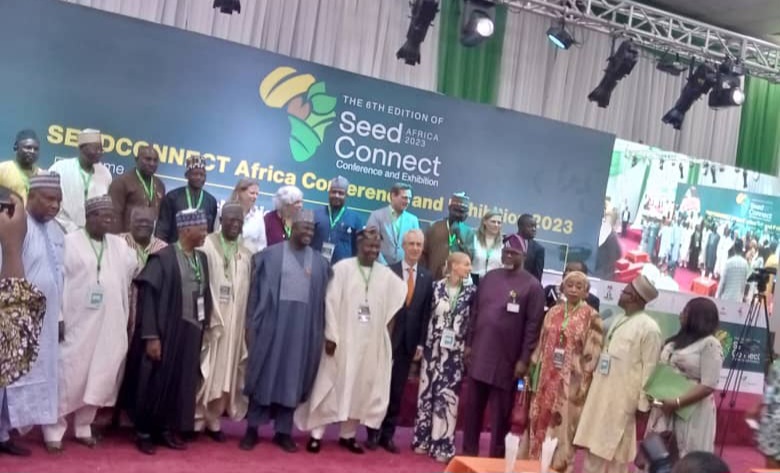
- Laments challenges of conflicts on global economy
- Vows to ensure Africa’s Food and Nutrition Security
The National Agricultural Seeds Council NASC, has on Tuesday, reiterated commitments to building a viable and resilient seed system in Africa regardless of the conflicts and challenges currently impacting negatively on food security.
The Ag Director-General of the council, Dr. Ishiaku Khalid, who made this known on Tuesday, during his opening/welcome address at the 6th Edition of SeedConnect Africa Conference/ Exhibition 2023 held in Abuja, stated that it is dedicated to the Global Declaration of Food Emergency and the role of Africa’s Seed Sector in creating a sustainable food system to ensure access to nutritious and affordable food both now, and in the future.
Ishiaku noted that whilst Africa is yet to fully recover from the detrimental impact of COVID 19 pandemic, the Russia-Ukraine conflict has posed another major threat to the global economy with many African countries being directly affected.
“The conflict is currently impacting negatively on food security in Africa by disrupting the availability and pricing in some food crops, particularly wheat and sunflower which may have its multiplier effect on other crops thereby disrupting the global production and supply chain system. Today, in Nigeria, we are witnessing new levels of threat, the food security situation is critical and has been impacted over the years by several factors especially by violent conflicts including the various levels of insurgency, armed banditry, the perennial farmer header conflicts, and separatist agitation across the country; other factors include rising inflation, rising poverty, and rising unemployment; Natural Disasters and other consequence of climate change impact. All these factors, continue to affect food production and availability of food engendering and compounding a cost-of-living crisis with severe effects on the cost of living of citizens and their ability to access food. The 6th edition of SEEDCONNECT 2023, is seeking a new level of freedom and change to mitigate these impacts and build a resilient seed system in Africa.” He added.
The Ag DG, emphasized that SEEDCONNECT Africa, has contributed immensely to the growth and development of the Nigerian Seed Systems as a result of the laudable contributions made by Stakeholders over the years.
Speaking further, Dr. Ishiaku, outlined few achievements of the council as a result of the implementation of brilliant ideas, decisions and innovation.
• “The amendment of the NASC Act. This has a flurry of innovations to bring us par with international best practices. This includes the introduction of stiffer penalties and solid foundation for the introduction of technology to police the Seed Industry. Under its Market Surveillance and Enforcement of Seed Quality Standards, NASC has seized substantial quantity of various crops seeds and varieties from unscrupulous seeds dealers nation-wide.
• The Introduction of a Turn-Key Electronic Seed Authentication System tagged ‘SEEDCODEX’ is fast becoming relevant in the Seed Industry as majority of the Seed Companies have fully subscribed to its implementation. With this, farmers are sure of using the right seed which has passed through the quality assurance processes of the NASC
• The NASC, through PVP Office is in the final stages of completing Nigeria’s membership process of the International Union for the protection of New Varieties of Plant (UPOV)
• Strengthening of the community based seed systems to provide the needed quality seeds to the hinter parts of the country. The systems is been formalized as we aim to reduce the quantity of seed exchange under the informal seed systems. NASC is working with partners such as ICRC, ATASP, Mercy corps, IITA, IFAD VCDP and a host of others to strengthen the system.
• Nigeria’s membership of the OECD Seed Scheme as the 62nd state thereby facilitating our access into the international seed market
• The current review of the Seed policy with the support of USAID Feed the Future Agribusiness has been approved by the National Council for Agriculture and Rural Development (NCARD).
• Our efforts to trace and track variety adoption through the introduction of DNA fingerprinting technology under the IMAGE project is currently ongoing. The first wave of the survey has been conducted. Seeds varieties have been drawn from farmers and other Stakeholders for DNA analysis.
• Diagnostic Certification and Molecular Analysis: NASC has continued to conduct various diagnostics analysis on virus indexing of Africa Mosaic Virus (ACMV), East Africa Cassava Mosaic Virus (EACMV) and Cassava Brown Streak Virus (CBS). This is to ensure viral free planting materials for vegetative propagated materials.
• Third-Party Certification: NASC initially engaged and trained about 74 Licensed Seed Inspectors (LSI) in five states namely Benue, Kogi, Abia, Imo and Oyo to carry Third Party Certification to compliment the services of NASC Certification Officers in aforementioned states under collaboration with BMGF sponsored BASICS project. The success of this led to engagement of 14 more LSI through scaling up to rice maize and potatoes by the Dutch Government Funded Collaborative seed project. The standard operating Protocols has been developed to guide their operations.”
He however tasked participants, other stakeholders to initiate, think up new ideas and innovations to move the African Seed Industry forward in tackling the global economic and food security challenges capable of bringing about the needed transformation in the Agricultural space.
Meanwhile, the chairman of the House Committee on Agricultural Production and Services, Hon. Bello Kaoje, commending the council, stakeholders for their dedication and commitment, also emphasized that the process will strengthen the spirit of collective partnership towards achieving food security.
He pledged commitment of the parliamentarians in ensuring and working towards the best interest of the citizenry.


