

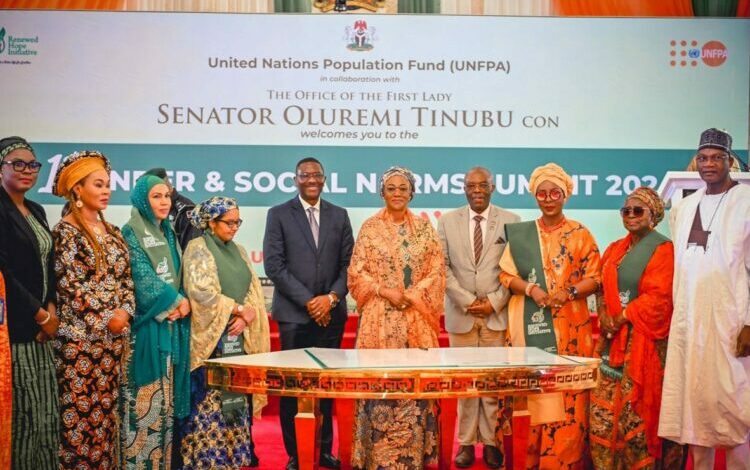
Amid growing concerns for the safety of women and children in Nigeria, First Lady Oluremi Tinubu has signed an agreement with governors’ wives to intensify efforts against Gender-Based Violence (GBV) and harmful social practices. The agreement was finalized yesterday in Abuja during the first ‘Gender and Social Norms Summit 2024,’ organized by the United Nations Population Fund (UNFPA) and the Renewed Hope Initiative in collaboration with the Office of the First Lady.
In her keynote speech, Mrs. Tinubu highlighted the persistent prevalence of harmful practices such as female genital mutilation (FGM), violence against women, and child marriage, which often result in severe conditions like Vesicovaginal Fistula (VVF). Despite ongoing efforts, she noted, these practices continue to increase, along with a disturbing rise in rape and GBV cases.
“Are we going to allow this trend to continue, or will we turn a blind eye?” she questioned, calling on law enforcement agencies, the Inspector-General of Police, the Attorney-General of the Federation, and the National Assembly to enact and enforce stricter laws and punishments for perpetrators of rape, sexual violence, and other GBV forms. “No guilty party should be allowed to go free and start running the streets looking for the next victim,” she emphasized.
Mrs. Tinubu advocated for state-specific action plans to allocate sufficient resources in government budgets to support gender equality and GBV prevention programs. She described the summit as a platform to create awareness, share lessons learned, and promote effective strategies for combating GBV and harmful practices.
UNFPA Officer-In-Charge, Mr. Koessan Kuawu, stated that family planning is vital for health, gender equality, and women’s empowerment but is often hindered by social norms and cultural barriers in many Nigerian communities. He praised the Federal Government for creating a supportive environment through legislation like the Violence Against Persons Prohibition (VAPP) Act of 2015 and implementing policies against FGM and child marriage.
While acknowledging the challenge of eliminating GBV and harmful social practices, Kuawu expressed optimism: “With the right resources, political will, and community support across the states, we can change the narrative for women and girls in Nigeria.”
Minister of Women Affairs and Social Development, Mrs. Uju Ohanneye, called for stricter penalties for offenders, noting that fear of legal consequences prevents crimes in other countries. She reaffirmed the ministry’s commitment to supporting and implementing programs aimed at eliminating GBV.
The Attorney-General of the Federation, Lateef Fagbemi (SAN), represented by Solicitor-General Mrs. Beatrice Agba, described GBV as violence rooted in unequal power dynamics and societal norms. He pointed out that these practices often stem from patriarchal structures and emphasized the justice system’s role in ensuring accountability, protection, and empowerment.
He added that the ministry is collaborating with stakeholders, including traditional rulers, faith-based organizations, and community justice systems, to address the beliefs and structures perpetuating violence against women and girls. A pilot phase is being initiated with area councils to support ongoing dialogues and initiatives on this subject.
Emir of Shonga, Haliru Yahaya, stressed the importance of involving traditional leaders in community programs against GBV and harmful practices. He noted that without the support of local leaders, initiatives might fail to gain traction in the community. Yahaya praised the efforts of the First Lady and the Ministry of Women Affairs, urging stakeholders to work closely with traditional leaders to ensure their support and understanding of initiatives aimed at protecting women and girls.
He emphasized that the success of these programs depends on engaging and enlightening local leaders, as they play a crucial role in shaping community attitudes. Yahaya called for a collaborative approach to empower women, stating that ignoring their contributions would hinder national progress.
The event was attended by the wives of state governors, state Commissioners of Women Affairs and Health, the Ministers of Women Affairs, youths, traditional rulers, and other stakeholders.


