

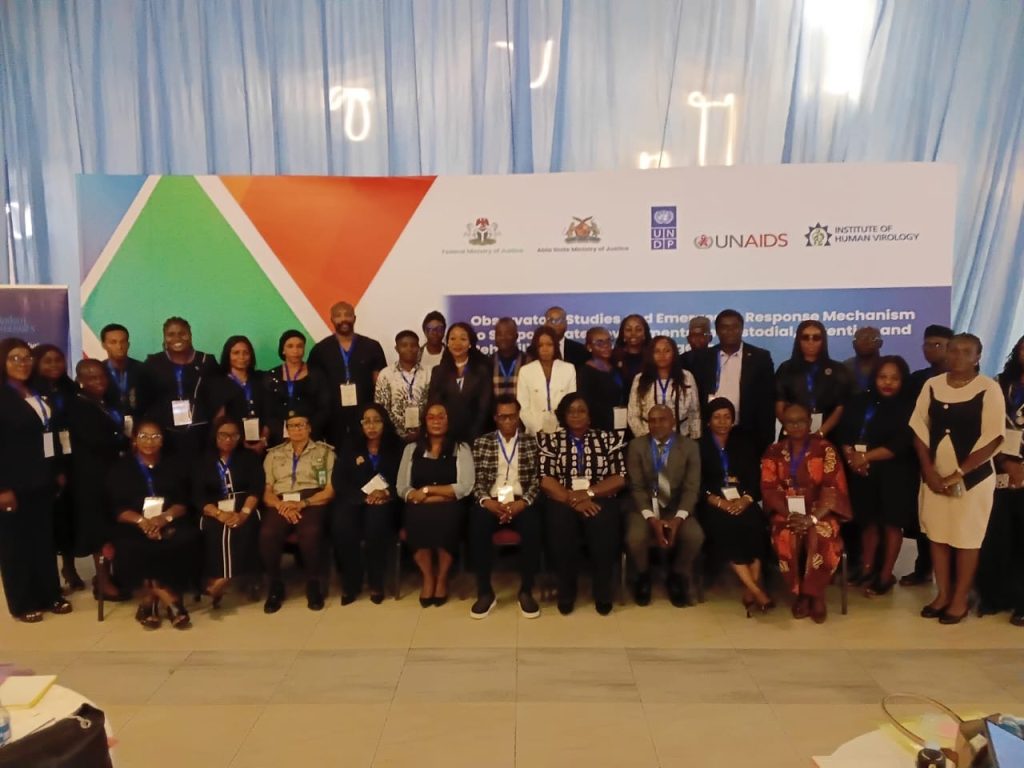
Field officers and legal officials drawn from across Nigeria have concluded a three-day intensive training ahead of a nationwide data collection exercise aimed at protecting the rights and health of inmates in custodial centres.
The capacity-building workshop, which wrapped up today, forms part of the High-Level Observatory initiative launched by the Federal Government in partnership with the United Nations Development Programme (UNDP) to monitor human rights and healthcare conditions, particularly HIV and Sexual and Gender-Based Violence (SGBV) vulnerabilities—within Nigerian correctional facilities.
Speaking at the close of the training, the principal investigator of the project and a professor of sociology at the University of Lagos, Prof. Michael Kunuji commended the enthusiasm and readiness of the participants.
“It’s been a very productive last three days because the participants have been very engaging,” Prof. Konoji said.
“I have absolute trust in this group. They have been equipped with the necessary skills, a deep understanding of the purpose of the study, and the protocols for entering these facilities. I am certain they have what it takes to deliver in the field.”
Also speaking, Mrs. Habiba Abu from Ministry of Justice noted that the interactive sessions brought together representatives from states on the national HIV priority list, including Abia, Anambra, and Adamawa, Taraba etc to prepare them to oversee custodial centres in their jurisdictions.
“It has been a highly interactive and conversational training, and everyone is responding well,” Mrs. Abu stated.
“The field officers have been thoroughly equipped and trained. We are very optimistic about the fieldwork and are just awaiting final clearance to commence.”
Participants from state Ministries of Justice described the workshop as an eye-opener that will transform both their fieldwork and their approach to criminal justice administration.
The Director of Legal and Head of the SGBV Unit at the Yobe State Ministry of Justice, Usman Ismaila, expressed gratitude to the Federal Ministry of Justice, the UNDP, and supporting non-governmental organisations for organising the training.
“I have learned a lot from the workshop, especially regarding quantitative and qualitative interviewing techniques, surveys, and key informant interviews,” Ismaila said. “Beyond data collection, this knowledge will greatly enhance my courtroom practice in terms of interviewing witnesses and cross-examination.”
Similarly, the SGBV Desk Officer at the Taraba State Ministry of Justice, Shalom Donald Maijankai, said the sessions exposed prosecutors to the hidden health and psychological realities inmates face behind closed doors.
“As prosecutors, we were primarily trained to secure convictions or remands, without always considering the health protocols required before an inmate goes in or after they come out,” Maijankai explained. “Learning how to handle inmates experiencing mental breakdowns and navigating sensitive interviews has completely broadened my perspective.”
Maijankai revealed that the Taraba delegation, alongside their Director of Public Prosecutions (DPP), has already mapped out a strategic deployment plan to cover the 12 correctional facilities in the state within the 10-day fieldwork window.
“We didn’t just come here to fill up seats; we have already programmed how to audit records of awaiting-trial inmates and those recently released. Kudos to the Federal Ministry of Justice and its partners for an initiative that will leave a lasting impact on our justice system,” she added.
With the training phase now completed, the field teams are set to deploy across the participating states to gather baseline data that will guide policy reforms and improve welfare conditions in Nigeria’s custodial centres.

