By He Yin, People’s Daily
Chinese President Xi Jinping recently replied to a letter from 61 young sinologists from 51 countries, who attended the 2025 World Chinese Language Conference in Beijing. Xi encouraged these young sinologists to continue to present a true, multi-dimensional and panoramic view of China to the world, contributing their wisdom and strength to building a community with a shared future for humanity.
His message reflects China’s enduring commitment in the new era to openness, inclusiveness and mutual learning among civilizations, laying a cultural foundation for global cooperation.
Originating in China and belonging to the world, China studies represents a shared intellectual heritage of humankind. Over generations, sinologists have produced scholarly contributions that transcend time and cultural boundaries.
The evolution of China studies mirrors global historical trends. As one Argentine scholar noted, “More than 20 years ago, studying China could feel lonely; today almost everyone is talking about China.” This remark highlights the growing global interest in China.
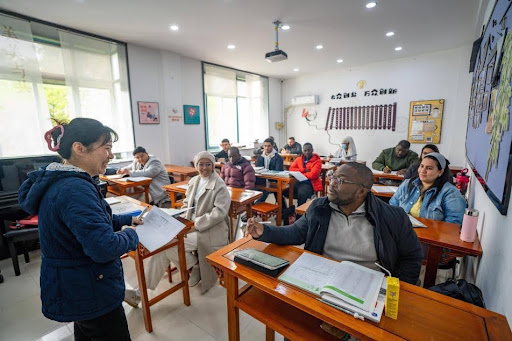
In recent years, an increasing number of international scholars have turned their attention to China, developing a genuine affinity for Chinese culture. Their work promotes academic exchange and mutual understanding, invigorating global cultural dialogue and fostering enduring international friendship and cooperation.
The rise of China studies also signifies the renewed vitality of Chinese culture in the new era. In South Africa, a young student learned Chinese to understand dialogue in the Chinese animated blockbuster “Ne Zha.” In Spain, a social media influencer promotes Chinese street food Jianbing Guozi in the Tianjin dialect, wrapping it with Spanish ham.
Sites such as Nanping, southeast China’s Fujian province, hometown of Zhu Xi, a great Chinese philosopher and a Confucian scholar of the Southern Song Dynasty (1127-1279), have become popular destinations for international students. Furthermore, vocational programs in Chinese-language livestreaming and e-commerce are in high demand among youth in Southeast Asia.
Around the world, interest in learning Chinese continues to grow. Today, more than 80 countries have incorporated the Chinese language into their national education systems, and the total number of international Chinese language learners and users has exceeded 200 million.
This linguistic enthusiasm is part of a broader cultural wave. Chinese music, film and television, games, online literature, and short dramas are reaching wider global audiences, creating vivid and dynamic cultural exchanges.
Such growing global interest underscores China’s openness and inclusiveness in the new era. As China embraces the world and shares its development opportunities, a two-way cultural dialogue continues to deepen.
The expansion of China’s visa-free entry policy has also facilitated cultural exchange, allowing more international visitors to experience its heritage firsthand. Many international influencers share their experiences online, offering authentic portrayals that broaden global perceptions of China. In the first half of this year, the number of foreign arrivals in China grew by 30.2 percent year on year, including 13.64 million visa-free entries, an increase of 53.9 percent.
As China’s development attracts greater global attention and the country continues to open up, a growing number of people worldwide recognize that understanding China and its culture is essential to unlocking opportunities for cooperation and achieving shared success.
In an increasingly interconnected world, civilizations can only address common challenges and pursue shared development through equality, exchange, and mutual learning. Conferences such as the World Chinese Language Conference, the World Conference on China Studies, and the World Conference of Sinologists are becoming key platforms for cross-cultural exchange, dialogue, and cooperation.
Looking ahead, China will continue to promote the principles of equality, mutual learning, dialogue and inclusiveness among civilizations, while expanding platforms for global engagement.
Understanding the present requires a deep appreciation of historical roots, and recognizing contemporary China necessitates an understanding of its cultural foundations. It is through mutual learning among civilizations that shared progress becomes possible.
It is hoped that more international scholars will engage in China studies, working alongside their Chinese counterparts to implement the Global Civilizations Initiative, foster mutual understanding, mutual respect and mutual trust among nations, and jointly contribute to the advancement of human civilization.
Blog
-
China studies contributes to mutual learning and shared development
-
China will firmly respond to any external interference in its internal affairs
By Yang Bojiang, Tang Yongliang
This year marks the 80th anniversary of the victory in the Chinese People’s War of Resistance Against Japanese Aggression and the World Anti-Fascist War, the 80th anniversary of the founding of the United Nations, and the 80th anniversary of Japan’s defeat.
At such a historically significant moment, the provocative remarks made by Japanese Prime Minister Sanae Takaichi regarding Taiwan and her refusal to retract them constitute a blatant challenge to the post-war international order, a serious breach of China-Japan relations, and an open affront to China’s core interests.
Taiwan’s return to China is an important outcome of the victory of World War II and a cornerstone of the post-war international order. In 1894, Japan launched the First Sino-Japanese War and forced the Qing government to sign the unequal Treaty of Shimonoseki the following year, seizing Taiwan and occupying it for 50 years. In 1945, Japan signed the Instrument of Surrender and formally accepted international legal documents including the Cairo Declaration and the Potsdam Proclamation, which stipulated the return of Taiwan to China. As territory once seized through aggression, Taiwan was rightfully restored to China both legally and factually.
Upholding the one-China principle is a solemn political commitment that Japan must continue to honor. In 1972, the two countries signed the Sino-Japanese Joint Statement and officially established diplomatic relations. Article 3 of the statement affirms that the Government of Japan fully understands and respects this stand of the Government of the People’s Republic of China, and it firmly maintains its stand under Article 8 of the Potsdam Proclamation. When the two countries signed the Treaty of Peace and Friendship in 1978, they codified the principles of this joint statement in legally binding form.
The third and fourth political documents between China and Japan, issued in 1998 and 2008, reaffirmed Japan’s commitment to the position on the Taiwan question set forth in the joint statement. The China-Japan Joint Declaration on Establishing a Partnership of Friendship and Cooperation for Peace and Development released in 1998 explicitly stated that Japan undertook to “continue to maintain its stand on the Taiwan question which was set forth in the Sino-Japanese Joint Statement” and “reiterated its understanding that there is one China.” It is stated in the document that Japan will continue to only maintain its exchanges of private and regional nature with Taiwan, which ruled out the legal possibility of Japan developing official relations with Taiwan.
In 2007, during then Japanese Prime Minister Yasuo Fukuda’s visit to China, the Japanese side further clarified that it would not pursue “two Chinas” or “one China, one Taiwan,” that it does not support “Taiwan independence,” and that it does not support Taiwan seeking to “join” the United Nations, nor any “United Nations membership referendum.”
In contrast to these solemn commitments, Takaichi’s recent remarks starkly contradict the principles established in these foundational documents, undermining the political foundation and mutual trust that underpin China-Japan relations.
Should Japan attempt to interfere in China’s internal affairs by force, it will undoubtedly face a firm and determined response from China. Japan’s militarist aggression inflicted immense suffering on the Chinese people during the 14-year war of invasion, with atrocities too numerous to recount. Under extremely difficult domestic and international conditions, the Chinese people persevered with extraordinary resilience and ultimately secured victory in the Chinese People’s War of Resistance Against Japanese Aggression.
Japan’s militarist aggression also brought devastating consequences upon its own people, and its post-war Pacifist Constitution emerged from reflection on the lessons of war. However, by disregarding the foundations of Japan’s post-war economic and social development — rooted in a commitment to peace and historical accountability — Takaichi appears intent on reviving its historical path of militarism driven by populist sentiment.
Any political attempt to exploit the Taiwan question for military expansion or any form of military adventurism that disregards prevailing global trends and China’s resolve for national reunification, will be met with resolute countermeasures by the Chinese people. Such actions are bound to draw firm opposition from peace-loving nations across Asia.
(Yang Bojiang, Tang Yongliang are distinguished research fellows with the Research Center for Xi Jinping Thought on Socialism with Chinese Characteristics for a New Era, Chinese Academy of Social Sciences.) -

Heightened vigilance required over Japan’s dangerous strategic drift
By Zhong Sheng, People’s Daily
Japanese Prime Minister Sanae Takaichi recently claimed at a Diet meeting that a Chinese attack on Taiwan could be a “survival-threatening situation” for Japan, warranting the exercise of collective self-defense rights. This implicitly suggests the potential for Japanese military involvement in the Taiwan question — an internal affair for China.
Such false rhetoric represents a serious infringement on China’s sovereignty and a direct challenge to the post-World War II international order. It has justifiably triggered concern and condemnation among members of the international community committed to upholding justice.
Despite the backlash, Takaichi has shown no sign of retracting her remarks, exposing the underlying historical misjudgments and highly dangerous historical, strategic, and security perspectives driving Japan’s right-wing forces. This trajectory demands close scrutiny, especially from neighboring Asian nations.
Takaichi’s fallacy regarding Taiwan reflects a concerning attempt to revive militarism. The narrative that “a Taiwan contingency is a Japan contingency” has long been a perilous argument in Japanese politics. It seeks to conflate China’s legitimate pursuit of national reunification with Japan’s security concerns. Within weeks of assuming office, Takaichi became the first sitting Japanese prime minister to explicitly link Taiwan to Japan’s right of collective self-defense, signaling a significant and dangerous shift in policy.
Japan’s historical use of the so-called “survival-threatening situation” as a pretext for military aggression, such as creating the September 18 Incident under the pretext of exercising the right of self-defense, and the ensuing war against China that inflicted immense calamities across Asia and the world, remains a stark reminder of the consequences of unchecked militarism. Takaichi’s invocation of similar justifications raises serious concerns about a possible resurgence of this perilous path.
Takaichi’s brazen remarks represent a flagrant provocation against historical justice. Japan bears significant historical responsibility for the Taiwan question. Following the First Sino-Japanese War, Japan seized Taiwan and imposed 50 years of colonial rule, committing countless atrocities. In 1945, Japan signed the Instrument of Surrender, formally accepting the Cairo Declaration and the Potsdam Proclamation, which stipulated that Taiwan be restored to China. The restoration of Chinese sovereignty over Taiwan marked the realization of historical justice.
This year marks the 80th anniversary of the victory in the Chinese People’s War of Resistance Against Japanese Aggression and the World Anti-Fascist War, as well as the 80th anniversary of Taiwan’s restoration. Instead of reflecting on its past aggression, Japan is stirring new tensions over the Taiwan question. Such actions not only constitute interference in China’s internal affairs but also undermine the political foundation of China-Japan relations and pose a serious challenge to the post-war international order.
The Taiwan question is at the very core of China’s core interests and is the red line that must not be crossed. The resolution of the Taiwan question and the realization of national reunification are matters solely for the Chinese people and brook no external interference.
Eighty years ago, the Chinese people defeated the Japanese aggressors. Today, that same determination, strength, and capability to defend national sovereignty and territorial integrity remain unshaken. Any attempt to interfere in or obstruct China’s reunification is bound to fail and will be seen as a serious miscalculation. Japan is firmly cautioned: provoking tensions under the pretext of Taiwan will only invite consequences for itself.
The historical legacy of Japanese militarism is deeply etched in regional memory, and its impact is neither forgotten nor forgiven by the Chinese people and others across the world. For a Japanese leader to publicly express, for the first time, the intent to militarily intervene in the Taiwan question and to issue an implicit threat of force against China is an alarming signal. It reveals a dangerous attempt by right-wing forces to erode the constraints of the Pacifist Constitution and advance a strategic agenda aimed at remilitarization.
In recent years, Japan has undertaken significant revisions to its security policies, including sustained increases in defense spending, the relaxation of arms export restrictions, and efforts to develop offensive military capabilities, which reflect a troubling shift toward military expansion. While touting itself as a “peace-loving nation” committed to a world free of nuclear weapons, the Takaichi administration has issued ambiguous and evasive statements regarding the Three Non-Nuclear Principles, raising concerns about a potential departure from these long-standing commitments. Notably, senior Japanese officials have suggested that the introduction of nuclear-powered submarines cannot be ruled out. These developments reveal a major and deeply concerning transformation in Japan’s policies.
Eighty years after Japan’s surrender, Takaichi’s recent remarks have touched a raw nerve across the region. Far from being a mere miscalculation, they amount to a deliberate provocation. In the face of such actions, people around the world, including the Chinese people, must remain vigilant and steadfast in defending peace and upholding justice.
(Zhong Sheng is a pen name often used by People’s Daily to express its views on foreign policy and international affairs.) -
Small private firm in E China achieves breakthroughs in new materials
By Li Rui, People’s Daily
Can an inanimate material “blush”?
At the International Exhibition on Plastics and Rubber Industries held in Shenzhen, south China’s Guangdong province this April, a newly developed elastomer drew attention at the booth of Dawn Group, a plastic raw material trader and distributor based in east China’s Shandong province. When illuminated, the material turned faintly pink, mimicking a human blush.
“This elastomer simulates human skin, enabling bionic robots to display more lifelike facial expressions,” explained Liu Lei, manager of the elastomer R&D department at Dawn Polymer, a subsidiary of Dawn Group engaged in research, development, production, sales and service of high-performance thermoplastic elastomer, modified plastic, master batch and other products.
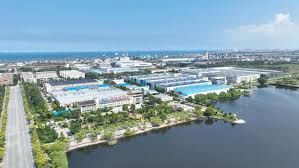
Now a global player in new materials, Dawn Group began humbly in 1991, when founder Yu Xiaoning, now chairman of Dawn Group, established the company with just five employees and 200,000 yuan ($28,064) in capital. A decade later, a critical turning point emerged when Yu learned of laboratory breakthroughs in high-performance thermoplastic vulcanizates (TPVs) from Professor Zhang Liqun of Beijing University of Chemical Technology.
“TPV combines the ease of plastic processing with the elasticity of rubber. It’s recyclable, environmentally friendly, and essential for sealing components in the automotive and aerospace sectors,” Yu said. “At the time, only the United States, Japan, the Netherlands, and Italy had mastered its production.”
Despite high risks and no precedent for industrialization, Yu invested over 10 million yuan to establish an R&D center in partnership with the university, determined to bring the technology from lab to market.
“There was no roadmap,” recalled Tian Hongchi, general manager of Dawn Polymer. “We had to refine everything manually, working from early morning to late at night.”
In 2006, their persistence paid off: Dawn Polymer launched China’s first TPV production line with fully independent intellectual property. Two years later, the technology won the second prize for technological invention.
The company soon pivoted to another critical material, hydrogenated nitrile rubber (HNBR), used in aerospace and high-performance machinery, and long monopolized by foreign firms. After nine years of intensive R&D, the company successfully produced China’s first HNBR block in 2019, making China the third country after Japan and Germany to master the technology with full intellectual property rights.
Today, Dawn Group is a cornerstone of Longkou’s high-end chemical industry and a flagship enterprise in Shandong Province’s specialized industrial clusters.
At the company’s new materials exhibition center, R&D Director Wang Hong pointed to rows of plastic pellets. “These are recycled materials that have ‘had a good night’s rest and regained their strength’.”
Wang employed the metaphor of “rest” to illustrate the rejuvenation of waste plastics: “Traditional recycling often degrades plastics quality, limiting their reuse,” he explained. “Our new technology enables plastics to be ‘reborn at the same grade.’ Just as rest restores human vitality, our process gives plastics a ‘deep sleep’ through advanced technology, restoring their original performance.”
In 2024, Dawn Group partnered with a subsidiary of Haier Smart Home, a global leader in smart home IoT ecosystems, to establish a joint venture focused on the R&D and production of recycled plastics. Haier Smart Home provides a steady supply of waste plastics from decommissioned appliances, while Dawn Group applies its proprietary technology to regenerate them. Tests show that Dawn Group’s recycled plastics emit only 0.452 tons of carbon per ton, an 80 percent reduction compared to virgin plastics.
“Companies once avoided recycled materials,” Wang noted. “Now they come to us.” Certified by leading international institutions, Dawn Group’s recycled plastics are now used not only in home appliances but also in automotive components. -
Aircraft repairing industry takes off in Hainan Free Trade Port
By Sun Haitian, People’s Daily
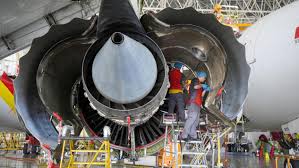
At a one-stop aircraft maintenance base in the Hainan Free Trade Port (FTP) in southern China’s Hainan province, rows of aircraft await inspection and repair as cross-border maintenance operations proceed efficiently. The resonant clang of tools underscores the busy yet orderly activity spanning the expansive tarmac.
“This one is from Jordan, and those two are from Vietnam. Our maintenance schedule is already booked through the end of 2026,” said Gu Zhilin, director of the aircraft maintenance base, owned by Grand China Aviation Maintenance, a subsidiary of HNA Technic.
Since commencing operations, the one-stop maintenance base has completed repairs on more than 2,400 aircraft, serving nearly 50 domestic and foreign airlines.
The Overall Plan for the Construction of the Hainan FTP calls for efforts to develop international shipping and aviation hubs along the New Western Land-Sea Corridor. As one of the key projects in building the free trade port, the one-stop aircraft maintenance base officially began operations in 2022.
“It was because of the Hainan FTP’s opening-up policy that the one-stop maintenance base was built,” Gu said.
“At first, some foreign airlines were skeptical. They wondered if Hainan had the capability to handle large aircraft maintenance,” Gu recalled. To win clients, his team actively promoted their services in the global market. In October 2022, they secured their first international order — to repair an Airbus A320 from a foreign airline.
“The whole team worked with maximum focus, double-checking every screw’s torque and every wire’s connection,” Gu said.
At one point, a key spare part was urgently needed. Procuring it internationally would have taken at least two weeks. “Thanks to the Hainan FTP’s bonded policies, we had sufficient reserves of aircraft materials on hand, ensuring smooth progress throughout the maintenance process,” he said. The team’s efficiency impressed the client, who gave them a thumbs-up on the spot.
When asked about the strength of policy support for businesses within the Hainan FTP, Gu detailed concrete benefits:.
A major advantage is lowered operational costs. Companies undertaking inbound aircraft repair projects are no longer required to pay deposits, freeing up substantial cash flow. Overall maintenance expenses have been reduced by 10 to 15 percent.
Efficiency has also improved significantly. With a bonded “aerospace materials supermarket,” all the required parts were available tax-free and could be accessed immediately. This greatly shortens the maintenance turnaround time.
Customs authorities have implemented new duty-free service models specifically for aircraft repair, creating green channels for both aircraft and spare parts. These measures ensure faster and smoother customs clearance for every inbound maintenance project.
These institutional innovations have turned first-time clients into regular ones. VietJet Air from Vietnam went from sending just one aircraft “to try it out” to nearly 20 aircraft for repair. Qatar Airways, satisfied with the service, signed a three-year painting contract worth nearly 100 million yuan ($14.05 million).
“In the past, we were waiting for planes to come to us. Now they’re lining up to get in,” Gu said with a smile.
Next to the one-stop maintenance base, Haikou Engine Service Co. is equally busy. Not long ago, the company successfully tested China’s largest 150,000-pound thrust-class engine test stand, capable of servicing major engine types worldwide — marking a significant leap in its engine overhaul capabilities.
“We’re working to close critical gaps in the industrial chain,” said company president Wu Dongyang. That determination, he explained, was made possible by the Hainan FTP’s “zero tariffs on self-use production equipment” policy.
“Since the policy took effect in 2021, we’ve saved around 100 million yuan in tariffs on imported equipment — real savings that allow us to focus resources where they matter most,” Wu noted.
Gu has also seen the benefits of an increasingly complete industry ecosystem. “At first, we could only handle airframe maintenance. If customers needed other services, the aircraft had to fly elsewhere. Now, the surrounding area offers a full range of support services,” he said.
According to Haikou customs, from January to October this year, the bonded maintenance trade value in the Haikou Airport Comprehensive Bonded Zone reached 47.86 billion yuan, a year-on-year increase of 71.8 percent. From zero-tariff imports of repair materials and production equipment to zero-tariff importation of entire aircraft, a full-fledged aviation industrial chain covering components, equipment, and complete aircraft is steadily taking shape in Hainan.
On Dec. 18 this year, the Hainan FTP will officially launch island-wide independent customs operation. With international exchanges becoming even more frequent, the skies over Hainan will grow busier than ever. “For us, that means a bigger stage,” said Gu, as another international flight touched down smoothly. Turning toward the hangar, he headed back to work. -

China shares development opportunities with the world through CIIE
People’s Daily reporters
The 8th China International Import Expo (CIIE) concluded in Shanghai on Nov. 10, having recorded $83.49 billion in one-year intended deals — up 4.4 percent from the previous edition and hitting a new high.
As the world’s second-largest consumption and import market, China is the only developing country to host a national-level import-themed expo. The consistent expansion of the CIIE reflects China’s commitment to opening its market to the world, reinforcing its role as a vital engine of global growth.
This year’s CIIE attracted a record number of exhibitors, underscoring the appeal and dynamism of China’s super-sized market. The enthusiasm among exhibitors and buyers translated into robust deal-making and record transaction values.
At the booth of French company IA Robotics, a smart humanoid robot capable of precision force control, which is able to detect a single strand of hair and lift 30 kilograms with ease, drew significant attention. “It’s our first time at the CIIE, and the outcomes have been highly rewarding,” said Li Shuangqi, general manager of IA Robotics.
“Over the past few days, we’ve engaged in productive discussions with a range of upstream and downstream partners, from core component suppliers to end-use clients. We also arranged reciprocal visits with neighboring exhibitors specializing in bionic sensors and gearbox manufacturing,” said Li.
The strength of the Chinese market lies not only in its size but also in its comprehensive industrial ecosystem and robust innovation capacity.
“Our products are now deeply integrated into China’s industrial chain,” said Henry Wu, managing director of the APAC region at the Sherwin-Williams Company. “China provides a well-developed industrial support system, abundant talent resources, and an open, inclusive business environment, creating a uniquely collaborative ecosystem.”
“We remain very confident in the Chinese market,” said Calvin McDonald, CEO of Lululemon Athletica Inc, a Canadian maker of sports leggings and tops. “With rising health awareness and growing demand for athletic wear, the Chinese market has become a key driver of our business growth.”
According to the World Openness Report 2025 released during the expo, China’s openness index grew 0.5 percent year on year in 2024, ranking 38th among 129 economies. With its inclusive and vibrant super-sized market, China continues to contribute significantly to global economic stability and growth.
Trade serves as a powerful catalyst for connectivity and shared prosperity. More Chinese and international enterprises are leveraging the CIIE platform to enhance brand visibility and accelerate expansion.
“The CIIE has opened a broader market access for us,” said Claudia, a Togolese exhibitor who secured distribution partnerships for her moringa seed oil products. She expressed hope to bring more African goods to China in the future.
This year, 163 companies from least developed countries (LDCs) took part in the CIIE, a 23.5 percent increase year on year. The African products section expanded, and the number of African exhibitors grew by 80 percent. As Elia George Kaiyamo, the Namibian ambassador to China, the CIIE not only links developed nations but also reflects the aspirations of the Global South for growth and opportunity. By boarding the “CIIE express,” more developing countries are gaining access to the fast track of development, he added.
A case in point is Theland, a New Zealand dairy brand, which has benefited from China’s streamlined customs procedures. “Thanks to an ‘inspection-and-release’ customs policy launched by multiple authorities, customs clearance can now take as little as 72 hours,” said Yan Zhijun, marketing director for the Asia-Pacific region at New Zealand dairy brand Theland. “‘CIIE speed’ and ‘CIIE innovation’ have greatly strengthened our confidence in future development.”
The success of Theland reflects China’s continued efforts to enhance institutional opening up. To date, China has signed 23 free trade agreements with 30 nations and regions. “From the business environment to market opportunities, we’ve witnessed China’s steady progress and open stance, which makes it a fertile ground for global enterprises,” said Hu Zhicheng, marketing manager at Hexagon Manufacturing Intelligence.
More than 80 supporting events, including trade negotiations and investment promotion sessions, were held during this year’s CIIE, generating a range of cooperative outcomes. The expo reaffirms China’s strategy of promoting high-level opening up to deepen reform and advance high-quality development, injecting greater stability and certainty into the world economy.
For the first time, a Central State-Owned Enterprises (SOEs) Buyers’ Corridor was introduced, featuring 14 centrally administered SOEs. Nearly 100 central SOEs sent more than 20,000 buyers, organized into 58 professional negotiation teams, further underscoring how China’s development needs are increasingly aligning with global cooperation opportunities.
The Medical Equipment & Healthcare Products exhibition area at the 8th CIIE was bustling with visitors exploring cutting-edge innovations. “This marks our eighth consecutive year at the CIIE,” said Ma Xiaoyi, general manager of public affairs at Dian Diagnostics Group. “The platform has enabled us to strengthen long-term technological partnerships and explore new avenues to engage with global innovation resources.”
As China advances along its path of modernization, it remains committed to deepening reform through high-level opening up and sharing development opportunities with the world, injecting greater stability and constructive momentum into the global economy. -
China’s intelligent computing power ranks among the world’s top
By Gu Yekai, People’s Daily
Driven by cutting-edge artificial intelligence (AI) theories and advanced computing architecture, China’s intelligent computing capacity is providing strong support for the development of AI.
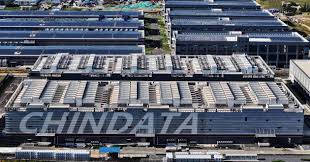
According to statistics released by China’s Ministry of Industry and Information Technology, as of the end of June 2025, China had 10.85 million standard racks in operation nationwide, with its intelligent computing power reaching 788 EFLOPS and storage capacity exceeding 1,680 exabytes.
China has released 1,509 large AI models, the highest number globally, accounting for a substantial share of the 3,755 models launched worldwide to date. Meanwhile, intelligent computing is increasingly integrated across industries, providing a foundational engine for innovation and industrial transformation.
By leveraging intelligent computing for efficient AI model training and inference, innovation in scientific research has accelerated significantly. Universities, research institutes, and computing enterprises across China are intensifying collaboration to expand intelligent computing applications across scientific domains.
At the Intelligent Computing System Lab of China’s Nankai University, researchers employed a high-efficiency open-source AI framework to enhance the inference speed of fundus image analysis by 2.4 times in vascular segmentation studies, facilitating the clinical viability of retinal imaging technologies.
In Shanghai, the Shanghai AI Laboratory, LinGang Laboratory, Shanghai Jiao Tong University, and Fudan University collaborated to identify and validate two new cancer targets within just two months, demonstrating the accelerating pace of scientific discovery enabled by intelligent computing.
Meanwhile, the Pengcheng Laboratory has integrated computing nodes from more than 20 cities via the China Computing Net. Supported by its “Peng Cheng Cloud Brain II,” the platform now supports tens of thousands of researchers nationwide.
Sun Maosong, executive deputy director of the Institute for Artificial Intelligence at Tsinghua University, emphasized the transformative role of AI in scientific research.
“In this AI-driven paradigm shift, intelligent computing should be used to address fundamental scientific questions,” he said. “Breakthroughs, such as predicting protein structures with large models, can lead to profound advancements across disciplines.
At the Yili Modern Intelligent Health Valley, a dairy production complex owned by Chinese dairy giant Yili Group in Hohhot, north China’s Inner Mongolia autonomous region, each dairy cow has an individual digital health record. Leveraging intelligent computing capacity provided by Alibaba Cloud and its Apsara operating system, Yili Group has established an intelligent computing infrastructure that offers a stable and flexible environment for deploying AI applications. Decision-making algorithms and generative AI models have been integrated into production and supply chain management.
“Traditional, manual methods for monitoring cow health are inefficient and prone to subjectivity,” said Cheng Guoqiang, director of digital technology at Yili Group’s digital technology center. “Now, with computer vision technology analyzing features such as eye condition, we can conduct real-time health monitoring and implement precision feeding, which has significantly enhanced milk quality.”
“Yili Group has developed more than 800 intelligent agents so far,” said Jia Zhaohui, senior director of solutions at Alibaba Cloud. “Large models cover 70 percent of supply chain scenarios, including order fulfillment, inventory turnover, and logistics efficiency, greatly reducing the risks of raw material expiration, stockpiling, and shortages.”
Since open-sourcing its first Qwen model in 2023, Alibaba has recorded over 600 million global downloads, with more than 170,000 derivative models developed, demonstrating the rapid proliferation and adaptability of its AI technology.
As high-speed train performance continues to increase, aerodynamic design has become a key focus in research and development. CRRC Corporation Limited, China’s leading train maker, has leveraged its extensive simulation and experimental data to build a standardized aerodynamic load database for high-speed trains. Using the deep-learning platform PaddlePaddle and its scientific computing suite, developed by Chinese tech giant Baidu, the company has developed an intelligent aerodynamic simulation model.
Compared with traditional simulation methods, the new large model reduces the simulation cycle from several days on traditional supercomputers to approximately 10 seconds on a single GPU. The overall simulation efficiency has increased by more than 30 times, with results deviating by less than 5 percent, marking a significant leap forward in intelligent optimization and rapid aerodynamic design.
Experts said that coordinated design and deep integration of software and hardware, along with continuous innovation in AI computing architecture, are essential to further integrate technologies such as large models and intelligent agents into the real economy, enabling AI to become a source of innovation across all industries.
“Innovation in intelligent computing relies on collaboration among enterprises, universities, and research institutions, as well as strong talent support,” said Hong Yuan, chief product officer of Tecorigin, a Chinese technology company specializing in high-performance AI chip architecture and intelligent computing systems.
The company has established joint research and development teams with Hunan University, Nanjing University of Posts and Telecommunications, and Soochow University to tackle research challenges. It has also developed an AI education and training platform based on its self-developed acceleration cards and software-hardware solutions, cultivating a skilled and practically oriented generation of young talent.
At present, the company’s high-density liquid-cooled intelligent computing clusters serve more than 200 universities and enterprises, supporting computing workloads exceeding 1.2 petaflops. -
Pinglu Canal takes shape, breathing new life into the Beibu Gulf
By Han Xin, People’s Daily
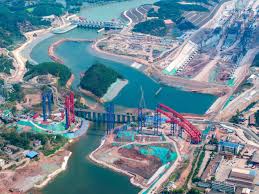
The Pinglu Canal, the first river-to-sea canal built since the founding of the People’s Republic of China, is nearing completion after over three years of intensive construction. As a backbone project of the New International Land-Sea Trade Corridor in western China, the canal spans 134.2 kilometers, linking the Pingtang River estuary in Nanning, Guangxi Zhuang autonomous region, to the Beibu Gulf via the Qinjiang River.
Today, the canal’s channel has largely taken shape. Towering sluice hubs line its banks, and its wide, sunlit waterway — stretching over 100 meters in width — quietly channels water toward the sea, signaling a transformative shift in regional connectivity.
A strategic link in the Chinese national infrastructure
A close look at the map of China reveals an intricate network of rivers crisscrossing Guangxi — from west to east, the Xijiang, Hongshui, Qianjiang, and Guijiang Rivers meander like the veins of a phoenix tree leaf. The Pinglu Canal serves as the vital petiole connecting this inland network to the sea, functioning as a “lifeline” for waterborne transport in the region.
The canal integrates with the Xijiang shipping trunk line upstream, extending westward via the Zuojiang and Youjiang Rivers into Yunnan, eastward through the Yujiang River to the Guangdong-Hong Kong-Macao Greater Bay Area, and northward via the Qianjiang and Hongshui Rivers into Guizhou. To the south, it opens into the Beibu Gulf, establishing a direct inland waterway to the sea. Designed as a Class I inland waterway, the Pinglu Canal will accommodate 5,000-ton vessels, enabling seamless connectivity between inland provinces and global maritime trade routes.
Despite its coastal geography, Guangxi’s rivers historically flow eastward into the Pearl River Delta due to complex topography and elevation differences, leaving the region without a direct river-to-sea route. As a result, goods from western China have traditionally faced extended transport routes to reach international ports.
“Inland waterway transport offers substantial advantages over rail and road. It handles higher cargo volumes, lower costs, and reduced emissions, making it a critical element in optimizing China’s transport infrastructure,” said Yan Qiang, director of the science and technology information department at the Pinglu Canal Group.
Yan emphasized that the canal’s construction is driven by its significant and unique strategic value. “Once operational, it will greatly enhance the efficiency of trade between Guangxi, southwestern China, ASEAN, and beyond. Compared with the route through Guangzhou Port, the canal will shorten the journey by over 560 kilometers and save more than 5.2 billion yuan (approximately $731 million) in annual freight costs.”
Engineering marvel with multifunctional benefits
The project encompasses the construction of a 134.2-kilometer-long, 5,000-ton-class inland waterway, three double-lane ship lock hubs, 27 newly built or reconstructed bridges, and supporting facilities.
“Unlike the Suez or Panama Canals, the Pinglu Canal is designed as a modern, multifunctional waterway that integrates navigation, flood control, water supply, irrigation, and ecological preservation,” explained Yan. “Constructing such a complex system under tight deadlines, within challenging terrain and strict environmental constraints, has been a formidable engineering challenge.”
Inside the project’s central command and control center, two real-time metrics that reflect the scale of construction progress: earth and rock excavation, and concrete volume poured.
To carve the canal’s path through mountainous terrain, excavation has reached 315 million cubic meters — nearly triple the volume excavated for the Three Gorges Project. Simultaneously, concrete pouring for the canal’s three cascade ship lock hubs — Madao, Qishi, and Qingnian — has reached 5.84 million cubic meters, enough to fill more than 2,300 standard swimming pools. These locks collectively manage a water level drop of approximately 65 meters, essential for vessel navigation.
“As of now, over 97 percent of the channel excavation has been completed, 80 percent of the banks have been reinforced, and water has been introduced to an initial 18-kilometer section,” said Mo Rixiong, project manager at CCCC Guangzhou Dredging Co., Ltd., noting that the project has entered its final phase.
A catalyst for regional development
As the Pinglu Canal nears full connectivity, its strategic importance is only beginning to unfold. Beyond its engineering significance, the canal is poised to become a powerful engine of regional development.
Major industrial projects are taking shape along its route. Nanning BYD New Materials Co., Ltd. has launched a lithium carbonate project with an annual capacity of 30,000 tons, while Sun Paper is investing 20 billion yuan in a fully integrated forest-pulp-paper industrial park. These key investments, driven by industry leaders, are laying the groundwork for an emerging industrial cluster and generating future cargo sources for the canal.
Supporting infrastructure is also undergoing rapid transformation. Key logistics nodes — such as Nanning Port and associated transportation facilities — are being modernized to ensure efficient operations once the canal is fully navigable.
“The Pinglu Canal is not just a major infrastructure project,” said Yan. “It’s a catalyst for unlocking industrial potential across the region, building a true ‘canal economic belt’ that drives regional development and prosperity.” -
Pursuing development, innovation, win-win cooperation through openness
By He Yin, People’s Daily
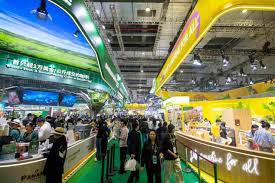
On Nov. 10, the 8th China International Import Expo (CIIE) concluded. The six-day event attracted 4,108 companies from 138 countries and regions, featuring 461 new products, technologies and services, and recording $83.49 billion in one-year intended deals.
At the opening ceremony of the first CIIE in 2018, Chinese President Xi Jinping noted that openness, innovation and inclusiveness have become the hallmark of Shanghai. They are also a vivid reflection of China in the new era and its commitment to development and progress. He stressed that it is important for all countries to open wider, pursue innovative growth, pursue inclusive development, and actively champion openness and cooperation in order to secure shared development.
Over the past eight years, the principles of openness, innovation and inclusiveness have remained central to the CIIE, reinforcing its role as a vital platform for promoting an open world economy and fostering common development.
As the world’s first national-level import-themed expo, the CIIE reflects China’s proactive approach to market openness and its expanding commitment to international cooperation. The event has grown in both scale and diversity, increasingly facilitating mutually beneficial partnerships.
According to the World Openness Report 2025 released at this year’s Hongqiao International Economic Forum, China’s openness has continued to expand despite a global trend toward contraction. In 2024, while the global openness index declined by 0.05 percent from 2023, China’s openness index rose by 0.5 percent. Between 1990 and 2024, China’s openness index advanced from 0.5891 to 0.7634, an increase of nearly 30 percent in 35 years.
Hamid Rashid, former chief of the Global Economic Monitoring Branch at the UN Department of Economic and Social Affairs, noted that at a time when global openness faces mounting challenges, China’s continued expansion of opening up sets a benchmark for building a more open world economy.
This year’s CIIE featured cutting-edge innovations across different sectors, including low-altitude economy, humanoid robots, smart healthcare, and green, low-carbon technologies. These global debuts highlight China’s evolving role as not only a key consumer market but also a critical hub for innovation and application.
International participants commented that China is not only a vast market, but also a vibrant hub for innovation and cooperation. With its flexible innovation ecosystem and diverse consumer demand, China is increasingly recognized as one of the world’s most vibrant innovation hubs.
Multinational companies are increasingly leveraging the CIIE platform to integrate key segments of their innovation chains into China and to strengthen collaboration in support of the country’s high-quality development trajectory.
In today’s deeply interconnected world, inclusiveness, mutual benefit and shared prosperity are the right path forward. Enterprises from 123 Belt and Road partner countries participated in this year’s CIIE, increasing 23.1 percent year on year, while those from least developed countries totaled 163, up 23.5 percent.
Following China’s extension of zero-tariff treatment to all 53 African countries with diplomatic ties, the number of African exhibitors grew by 80 percent this year. For the first time, the Hongqiao International Economic Forum hosted discussions on enhancing economic resilience and sustainable agricultural development in the Global South. These efforts aimed at reinforcing the development rights and amplifying the voices of developing countries.
As Dorothy Tembo, deputy executive director of the International Trade Center, highlighted that the CIIE enables small and medium-sized enterprises from more countries to share China’s vast market opportunities, facilitating a more inclusive and equitable distribution of development benefits worldwide.
As a vital platform for advancing open cooperation and promoting global economic growth, the CIIE continues to reflect China’s enduring commitment to sharing opportunities and pursuing common development with the world.
Looking ahead, China will remain committed to high-level opening up, advancing development and innovation, promoting win-win cooperation through openness, and creating new opportunities for the world through the new achievements of Chinese modernization. -

Breaking: FBNQUEST: Nestoil and Neconde are not under any receivership
The purported publication that Nestoil and Neconde are under Receivership is blatantly false and an attempt to prejudice on going pending suit between First Bank Trustees and FBNQuest Merchant against Nestoil and others.
It is pertinent to note that an ex-parte application by plaintiffs for judicial recognition of their purported Receiver manager was refused. Further more all issues requesting Judicial recognition in the substantive suit by the plaintiffs on behalf of the secondary lender Banks led by First Bank are still pending for hearing at the Federal High Court Ikoyi Lagos.
Consequently any publication that Nestoil and Neconde are under Receivership is totally false ,prejucial and contempt of court.
An inchoate Receiver Manager appointment with out recognition by the court as in this case has no powers to seize the defendants assets including freezing of its accounts and that of its Directors.
The plaintiffs and its purported Receiver manager can not blow hot and cold at the same time.Nigeria law forbids self help.
The plaintiffs having gone to court,they should as lawful citizens await final determination of their suits for judicial recognition of the Receiver ship amongst other reliefs.