Category: News

  • Youths Unveil Bold Ideas as CiCMED Future Planters Bootcamp Rounds Off in Akwanga

    Youths Unveil Bold Ideas as CiCMED Future Planters Bootcamp Rounds Off in Akwanga

    By Abel Leonard, Lafia

    Young Nigerians have showcased groundbreaking solutions to national challenges as the Community Initiative for Character Moulding and Entrepreneurship Development (CiCMED) concluded the 2025 Future Planters Bootcamp in Akwanga, Nasarawa State.

    The event, which started on August 25 and ended on August 31, featured a week-long series of activities that brought together participants from across the country for sessions on leadership, entrepreneurship, innovation, and policy development. Teams worked on projects addressing agriculture, climate resilience, youth empowerment, and the creative economy.

    Some of the standout innovations included greenhouse vegetable farming for year-round food security, cassava waste recycling into sustainable products, cold storage facilities to reduce post-harvest losses, and eco-friendly briquettes for cooking stoves aimed at reducing deforestation. Others explored creative tools such as songs and storytelling to foster unity and national renewal.

    CiCMED’s Executive Director, Kefas Elisha Tigga, in an interview with journalists on Wednesday, said the initiative had become a platform for young Nigerians to plant seeds of change.

    “This bootcamp is more than a programme; it is a movement of young Nigerians planting seeds of change,” Tigga said. “We are calling on the public, organizations, and development partners to support these youths by funding their innovations and rewarding their brilliance.”

    The finalist groups include #TeamHopeFP2025, #TeamRootsFP2025, #TeamHarvestFP2025, and #TeamGreenFP2025, which are still actively engaged in online activities as part of the build-up to the Grand Finale slated for October 4, 2025, where the winning projects will be unveiled.

    At the finale, CiCMED is expected to launch the Future Planters Creative Studios and present original songs produced by the teams.

    The organisation has also appealed for support to provide seed funding and mentorship to help scale the most promising ideas.

    For inquiries and partnership opportunities, CiCMED can be reached via 0811 242 5254, 0810 838 4177, or through its website www.cicmedngo.com.

  • US Seizes Record 300,000kg of Meth Precursor Chemicals Bound for Mexico’s Sinaloa

    US Seizes Record 300,000kg of Meth Precursor Chemicals Bound for Mexico’s Sinaloa

    The United States has announced the largest seizure of methamphetamine precursor chemicals in its history, intercepting **more than 700,000 pounds (300,000 kilograms)** of substances allegedly en route from China to Mexico’s powerful **Sinaloa cartel**.

    US Attorney for the District of Columbia, **Jeanine Pirro**, disclosed the operation on Wednesday during a press briefing at the **Port of Houston, Texas**, where the massive haul was displayed in a warehouse. The consignment, she said, consisted of **13,000 blue barrels**, plastic-wrapped and shipped from **Shanghai** on two vessels before being seized **“on the high seas”** last week.

    “This is the largest seizure of precursor chemicals used to manufacture methamphetamine in US history,” Pirro declared, underscoring the scale of the cartel’s operations and the collaborative effort that led to the bust.

    According to **Todd Lyons**, Acting Director of US Immigration and Customs Enforcement (ICE), the shipments were first consolidated in **Panama** with assistance from “foreign law enforcement partners” before being redirected to Houston for processing.

    Officials said the chemicals were destined for **clandestine laboratories** operated by the Sinaloa cartel, a group long accused of fueling the US drug crisis with meth, fentanyl, and other narcotics.

    Authorities have not disclosed whether arrests were made in connection with the seizure but described the operation as a major blow to the cartel’s global supply chain.

  • Kano Pilgrims Board Fixes ₦8.5m Deposit for 2026 Hajj Registration

    Kano Pilgrims Board Fixes ₦8.5m Deposit for 2026 Hajj Registration

    The Kano State Pilgrims Welfare Board has announced that intending pilgrims must pay a minimum deposit of **₦8.5 million** to secure a slot for the 2026 Hajj exercise.

    The directive was disclosed by the board’s Director-General, **Lamin Danbappa**, during a meeting with management staff, local government Hajj centre officers, and board members.

    In a statement issued by the board’s Public Relations Officer, **Sulaiman Dederi**, the DG explained that the deposit was fixed by the **National Hajj Commission of Nigeria (NAHCON)** and would be collected exclusively through bank drafts submitted via Local Government Hajj Centres.

    Kano State has been allocated **5,684 slots** for the 2026 pilgrimage. Collection of deposits begins immediately and will run until **October 5, 2025**, when the final fare for the pilgrimage will be officially announced.

    Danbappa urged intending pilgrims to make payments promptly in accordance with the Kingdom of Saudi Arabia’s schedule, stressing that registration requires a valid international passport and **eight passport-sized photographs**.

    Meanwhile, reports indicate that the **Federal Capital Territory (FCT) Hajj Board** has also commenced registration for 2026 pilgrims, pegging the same **₦8.5 million** minimum deposit.

  • Indigenous Contractors Protest Over ₦4 Trillion Debt

    Indigenous Contractors Protest Over ₦4 Trillion Debt

    …Urges Tinubu’s urgent intervention as unpaid projects push members into debt and despair

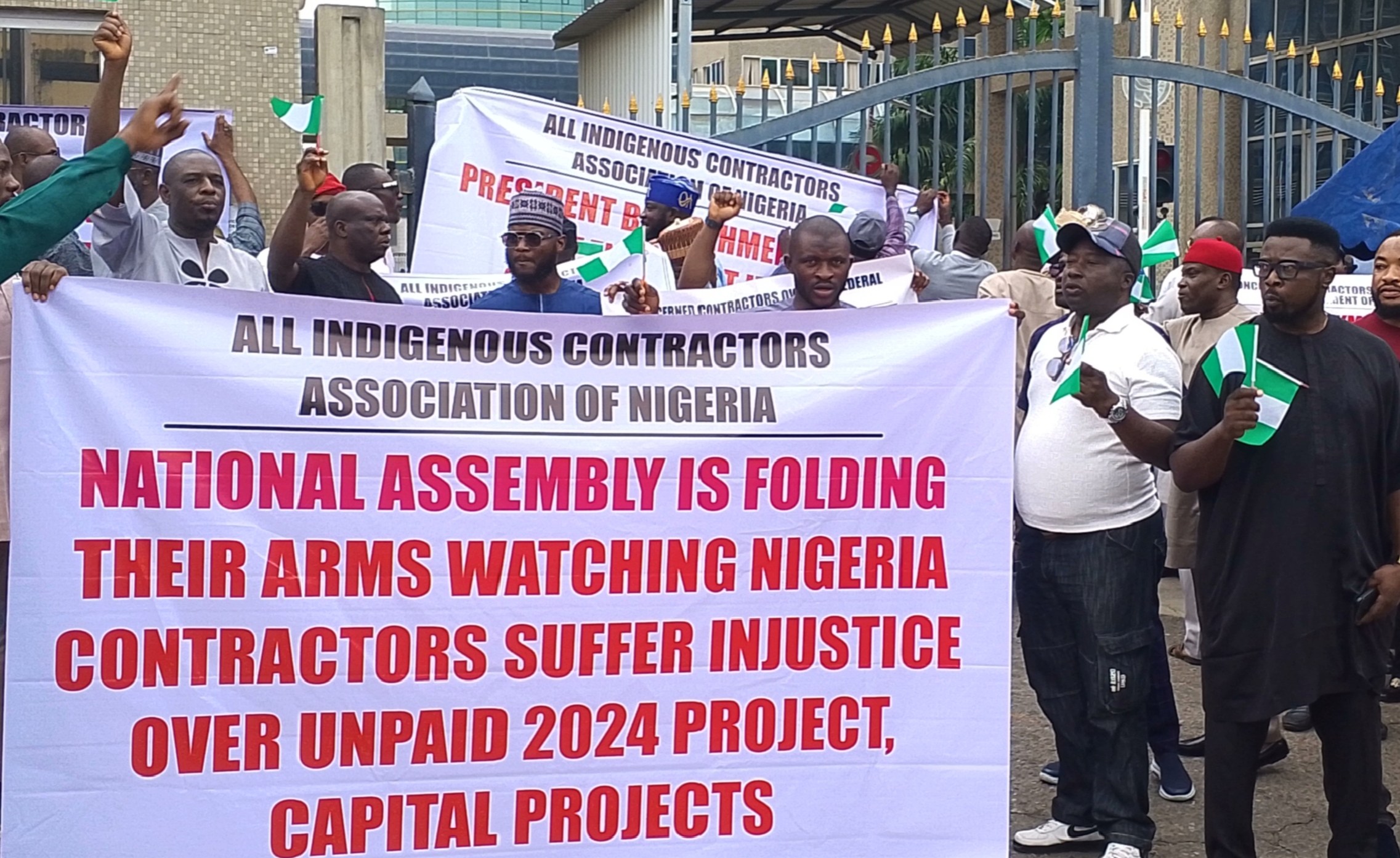
    The All Indigenous Contractors Association of Nigeria (AICAN) has raised alarm over more than ₦4 trillion in unpaid government contracts, warning that the debt crisis is crippling businesses, ruining families, and pushing thousands of contractors into debt, sickness, and financial ruin.

    Speaking during a protest in Abuja on Wednesday, the association’s president, Jackson Nwosu, said despite government claims that payments for the 2024 capital projects had been released, less than one percent of indigenous contractors had received funds.

    “They’ve been owing us since last year for over 2,024 capital projects,” Nwosu said. “Out of more than 15,000 contractors, they have only paid about seven. Yet, they go around claiming that all payments have been settled. That is a lie. If they had paid us, we would not be on the streets.”

    He lamented that many members had died while waiting for payment, while others were unable to pay school fees, salaries, or service loans taken from banks.

    “We are dying. Financial institutions are on our necks every day because the government claims to have paid us, but they haven’t. We will remain on the streets until every last contractor is paid,” he declared.

    The association further alleged that ministries and agencies had stopped forwarding approvals to the Ministry of Finance due to a funding freeze, worsening the backlog of unpaid projects.

    Also speaking, the National Secretary of the association, Babatunde Seun, accused government officials of insincerity and selective payment, noting that contractors had fulfilled their obligations but were left stranded because warrants issued for February and March were not backed with cash.

    “They always pay just one or two people and leave the rest,” he said. “We met with the Finance Minister and the Accountant-General, who assured us of payments within 48 hours. But nothing has happened. Some of us have lost our cars and properties to banks. We cannot even pay workers or our children’s school fees.”

    Seun appealed directly to President Bola Tinubu, urging him to intervene personally. “He was once a contractor and understands this struggle. If he instructs the Finance Minister to pay today, the money will be released,” he added.

    Some members shared their personal ordeals, including Davison Ahamefule, who revealed that he executed a government contract in 2011 and only received half payment two years later.

    “They verified the project, but since then nothing has been paid. The interest rates from banks have swallowed everything. I am pleading with the government to pay us,” he said.

    The contractors stressed that while members had avoided legal action in hopes of an amicable resolution, they might be forced to head to court if the stalemate persists.

    “We are not violent people. But if this continues, frustration will push more Nigerians out of the country. All we are asking is to be paid for the work we have done.”

  • Rivalry Between Alaafin and Ooni Stirs Concerns Over Unity in Yorubaland

    Rivalry Between Alaafin and Ooni Stirs Concerns Over Unity in Yorubaland

    By Dr. Adebayo Faleke

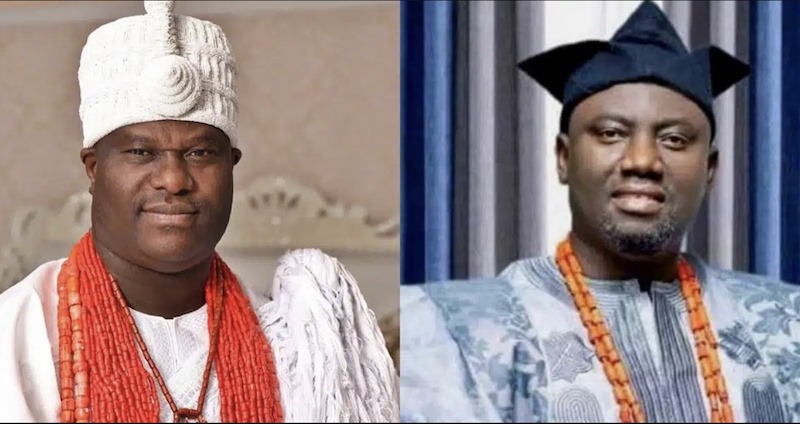
    The historic rivalry between the Alaafin of Oyo and the Ooni of Ife has resurfaced, raising concerns about unity within the Yoruba traditional leadership structure, widely referred to as the House of Oduduwa.

    Observers note that the dispute, which is being interpreted as a battle for supremacy between the two revered thrones, reflects long-standing tensions rooted in colonial interference and subsequent political influences in the region’s royal institutions.

    Historians trace the origins of the rivalry to the colonial era, when British authorities, under indirect rule, altered the traditional hierarchy of Yoruba kingship. Some crowns were elevated, while others were weakened, creating divisions that had lasting consequences.

    Post-independence politics further deepened these cracks. Politicians often leveraged traditional institutions for partisan advantage, with succession disputes and royal authority increasingly shaped by political patronage rather than ancestral or cultural legitimacy.

    Analysts warn that the current tensions could distract from urgent socio-economic challenges facing the Southwest, including insecurity, youth unemployment, poverty, and the collapse of local industries. They argue that Yoruba monarchs, historically seen as custodians of unity and protectors of the people, should be at the forefront of finding solutions.

    Calls have grown for the region’s royal councils to work together with state governments and community groups to strengthen regional security initiatives such as Amotekun, revive agro-industrial projects, and address deteriorating education standards.

    “The crowns must serve as instruments of leadership and progress, not rivalry,” one commentator said. “The Yoruba nation cannot afford a divided House of Oduduwa at a time when insecurity and economic hardship are pressing issues.”

    Stakeholders are urging the Alaafin, the Ooni, and other traditional rulers to set aside rivalry and establish a united front to defend Yoruba cultural heritage while addressing contemporary governance and development challenges.

  • Indigenous Contractors Decry Unpaid Capital Projects, Call For Tinubu’s Intervention

    Indigenous Contractors Decry Unpaid Capital Projects, Call For Tinubu’s Intervention

    The All Indigenous Contractors Association of Nigeria (AICAN) has accused the Federal Government of failing to pay for completed capital projects worth over ₦4 trillion, warning that thousands of contractors across the country are being pushed into debt, sickness, and financial ruin.

    Speaking during a protest in Abuja on Wednesday, the association’s president, Jackson Nwosu said despite government claims that payments for the 2024 capital projects had been made, less than one percent of indigenous contractors had received funds.

    “They’ve been owing us since last year for over 2,024 capital projects,” Nwosu said. “Out of more than 15,000 contractors, they have only paid about seven. Yet, they go around claiming that all payments have been settled. That is a lie. If they had paid us, we would not be on the streets.”

    Nwosu lamented that many of their members had died waiting for payment, while others struggled to pay school fees and settle debts with banks.

    “We are dying. Financial institutions are on our necks every day because the government claims to have paid us, but they haven’t. We will remain on the streets until every last contractor is paid,” he said.

    The group alleged that ministries and agencies had stopped forwarding approvals to the Ministry of Finance due to a funding freeze, worsening the backlog.

    Also, the National Secretary of the association, Babatunde Seun, echoed the president’s concerns, accusing government officials of insincerity and selective payment.

    He said contractors had fulfilled their obligations by completing projects but were left stranded because warrants issued for February and March were not backed by cash.

    “They always pay just one or two people and leave the rest,” he said. “We met with the Finance Minister and the Accountant-General, who assured us of payments within 48 hours. But nothing has happened. Some of us have lost our cars and properties to banks. We cannot even pay workers or our children’s school fees.”

    Seun appealed directly to President Bola Tinubu, urging him to intervene personally. “He was once a contractor and understands this struggle. If he instructs the Finance Minister to pay today, the money will be released,” he said.

    Some members narrated personal ordeals, including Davison Ahamefule, who said he executed a government contract in 2011 and received only half payment two years later.

    “They verified the project, but since then nothing has been paid. The interest rates from banks have swallowed everything. I am pleading with the government to pay us,” he said.

    The contractors said while they have avoided legal action in hopes of an amicable resolution, they may be forced to explore court options if the stalemate persists.

    “We are not violent people,” Seun stressed. “But if this continues, frustration will push more Nigerians out of the country. All we are asking is to be paid for the work we have done.”

  • Port Harcourt Refinery Shutdown: CSOs Accuse NNPCL Boss Of Economic Sabotage

    Port Harcourt Refinery Shutdown: CSOs Accuse NNPCL Boss Of Economic Sabotage

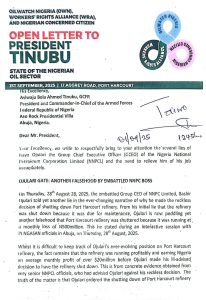
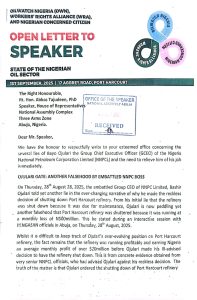
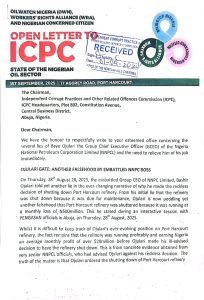
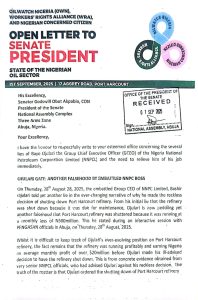
    The Independent Corrupt Practices and Other Related Offences Commission for Nigeria (ICPC) has been urged to investigate and take action against Bayo Ojulari, Group Chief Executive Officer (GCEO) of the Nigeria National Petroleum Corporation Limited (NNPCL), over allegations of economic sabotage and lying.

    According to an open letter addressed to the ICPC Chairman on Monday September 1, 2025, Ojulari allegedly ordered the shutdown of the Port Harcourt refinery despite it being profitable, with an average monthly net profit of over $20 million. The letter claims that Ojulari’s decision was motivated by plans to sell the refinery at scrap value to a company allied with him and to divert the refinery’s crude oil allocation for personal gain.

    The group also addressed the open letter to President Bola Tinubu, Senate President Godswill Akpabio, and Speaker of the House of Representatives Tajudeen Abbas regarding their recent concerns about the management of the state-owned refinery.

    The letter further alleges that Ojulari has been peddling falsehoods about the refinery’s operations, initially claiming that it was shut down for maintenance and later stating that it was running at a monthly loss of N500 million.

    An economic analysis of the refinery’s operations, attached to the letter, shows that the refinery was generating an average monthly net profit of $20 million under various scenarios. The analysis suggests that Ojulari’s claims of the refinery running at a loss are false and that the shutdown was a deliberate act of economic sabotage.

    The signatories to the letter, including OilWatch Nigeria, Workers’ Rights Alliance, and Nigeria Concerned Citizens Watch, are calling for Ojulari’s immediate removal from office and an independent investigation into the refinery’s shutdown.

    The letter reads in part:

    On Thursday, 28th August 28, 2025, the embattled Group CEO of NNPC Limited, Bashir Ojulari told yet another lie in the ever-changing narrative of why he made the reckless decision of shutting down Port Harcourt refinery. From his initial lie that the refinery was shut down because it was due for maintenance, Ojulari is now peddling yet another falsehood that Port Harcourt refinery was shuttered because it was running at a monthly loss of N500million. This he stated during an interactive session with PENGASAN officials in Abuja, on Thursday, 28th August, 2025.

    Whilst it is difficult to keep track of Ojulari’s ever-evolving position on Port Harcourt refinery, the fact remains that the refinery was running profitably and earning Nigeria an average monthly profit of over $20million before Ojulari made his Ill-advised decision to have the refinery shut down. This is from concrete evidence obtained from very senior NNPCL officials, who had advised Ojulari against his reckless decision. The truth of the matter is that Ojulari ordered the shutting down of Port Harcourt refinery

    because he had made plans to sell the refinery (at scrap value) to AYM Shafa Group, a company allied with both himself and Bashir Haske (son -in law to Atiku Abubakar, who was recently declared wanted by the EFCC). Secondly, Ojulari wanted the monthly crude oil allocation for Port Harcourt refinery to be diverted to his friends and cronies, for sale as spot cargoes for personal gain.

    By shutting down a fully operational refinery, Ojulari has committed unforgivable economic sabotage against the government and people of Nigeria, and no amount of lying and double speak can change that fact. We call for an independent economic analysis of the refinery’s operations, prior to its unceremonious closure by Ojulari. Even the most uneducated eye can spot Ojulari’s lie once they look at the economic analysis provided below.

    This refinery was running smoothly and making over $20million monthly for Nigerians. It was not running at a loss as falsely claimed by Ojulari.
    Please see high-level economic analysis for the refinery, below:

    Economic Analysis of Port Harcourt Refinery Operations.
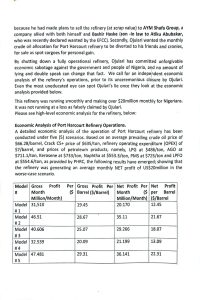
    A detailed economic analysis of the operation of Port Harcourt refinery has been conducted under five (5) scenarios. Based on an average prevailing crude oil price of $66.28/barrel, Crack C5+ price of $635/ton, refinery operating expenditure (OPEX) of $7/barrel, and prices of petroleum products, namely, LPG at $486/ton, AGO at $711.1/ton, Kerosene at $733/ton, Naphtha at $553.3/ton, PMS at $725/ton and LPFO at $554.6/ton, as provided by PHRC, the following results have emerged; showing that the refinery was generating an average monthly NET profit of US$20million in the worse-case scenario.

    Model
    # Gross Profit Per Month ($ Million/Month) Gross Profit Per Barrel ($/Barrel) Net Profit Per Month ($ Million/Month) Net Profit per Barrel ($/Barrel
    Model
    # 1 31,510 19.45 20.170 12.45
    Model
    # 2 46.51 28.67 35.11 21.67
    Model
    # 3 40.606 25.07 29.266 18.07
    Model
    # 4 32.539 20.09 21.199 13.09
    Model
    # 5 47.481 29.31 36.141 22.31

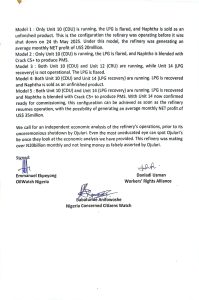
    Model 1 : Only Unit 10 (CDU) is running, the LPG is flared, and Naphtha is sold as an unfinished product. This is the configuration the refinery was operating before it was shut down on 24 th May 2025. Under this model, the refinery was generating an average monthly NET profit of US$ 20million.

    Model 2 : Only Unit 10 (CDU) is running, the LPG is flared, and Naphtha is blended with Crack C5+ to produce PMS.

    Model 3 : Both Unit 10 (CDU) and Unit 12 (CRU) are running, while Unit 14 (LPG recovery) is not operational. The LPG is flared.

    Model 4: Both Unit 10 (CDU) and Unit 14 (LPG recovery) are running. LPG is recovered and Naphtha is sold as an unfinished product.

    Model 5 : Both Unit 10 (CDU) and Unit 14 (LPG recovery) are running. LPG is recovered and Naphtha is blended with Crack C5+ to produce PMS. With Unit 14 now confirmed ready for commissioning, this configuration can be achieved as soon as the refinery resumes operation, with the possibility of generating an average monthly NET profit of US$ 35million.

    We call for an independent economic analysis of the refinery’s operations, prior to its unceremonious shutdown by Ojulari. Even the most uneducated eye can spot Ojulari’s lie once they look at the economic analysis we have provided. This refinery was making over N20billion monthly and not losing money as falsely asserted by Ojulari.

  • CSOs Laud Refugee Commission’s Open-Door Policy, Pledge Stronger Partnership, Support for National Impact

    CSOs Laud Refugee Commission’s Open-Door Policy, Pledge Stronger Partnership, Support for National Impact

    •  As Federal Commissioner Reaffirms Commitment to Transparency, Unveils Plan for Dedicated CSO Desk Office

    Over 50 Civil Society Organizations (CSOs) from across Nigeria on Thursday converged at the headquarters of the National Commission for Refugees, Migrants and Internally Displaced Persons (NCFRMI), Abuja, on a high-level courtesy visit to Federal Commissioner and Chief Executive Officer, Aliyu Tijani Ahmed.

    The powerful delegation was jointly led by Comrade Splendour Agbonkpolor, Chairman of the CSO Budget Implementation, Assessment, Monitoring and Evaluation Committee (CBIAMEC), and Ogakwu Dominic, President of the Civil Society Groups for Good Governance (CSGGG), alongside leaders of several civil society organizations in Nigeria.

    Welcoming the delegation, Aliyu Tijani Ahmed commended the critical role of CSOs in strengthening democracy, accountability, and policy implementation. He emphasized that under his stewardship, the NCFRMI has embraced an open-door policy designed to encourage dialogue, inclusivity, and collaboration in the humanitarian sector.

    The Commissioner highlighted some of the Commission’s notable achievements, particularly in states such as Nasarawa, Benue, amongst others, where thousands of displaced persons, migrants, and asylum seekers have benefited from timely relief interventions, shelter support, and empowerment initiatives.

    “Our mission is not just to provide immediate relief but to restore dignity, build resilience, and ensure long-term rehabilitation for our displaced brothers and sisters. We are determined to leave no one behind,” Ahmed declared.

    Also in a major step to deepen transparency, the Federal Commissioner agreed to suggestions by announcing plans to establish a dedicated CSO Desk Office within the Commission. According to him, the new desk will serve as a direct liaison point with civil society groups, ensuring smooth collaboration, stronger oversight, and due diligence in all NCFRMI activities.

    Speaking on behalf of the delegation, Comrade Splendour Agbonkpolor hailed the Commissioner’s performance, describing the visit as “one of a kind.” He noted that Aliyu Tijani Ahmed has set a new benchmark for leadership in public service.

    “As a performing public steward, you have earned the confidence of civil society. The CSOs present here today, and those across the wider coalition, will continue to support and rally around you to ensure that the Commission achieves its mandate,” Agbonkpolor stated.

    Corroborating his remarks, Ogakwu Dominic lauded Ahmed for his humility, responsiveness, and openness to partnership. He stressed that the collaboration between the Commission and CSOs would set a new standard for humanitarian governance in Nigeria.

    The visit not only underscored the growing synergy between government and civil society but also signaled a new chapter of accountability, inclusivity, and partnership in addressing Nigeria’s displacement and migration challenges.


  • CSOs Laud Alia’s Neutrality, Respect for Democratic Values

    CSOs Laud Alia’s Neutrality, Respect for Democratic Values

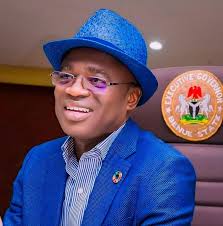
    The Center for Social Justice and Political Reform in collaboration with Transparency International have described the Governor of Benue State, Rev. Fr. Hyacinth Alia as a true democrat who has brought a new perspective to politics and leadership in the country.

    The CSOs also expressed satisfaction with the pace of development currently ongoing in the state noting that the governor’s commitment to delivering dividends of democracy in the state are unprecedented especially in the current democratic dispensation.

    In a press release signed by Tosin Fagbemi, a copy of which was sighted by our correspondent, quoted the CSOs as describing the political situation in Benue as “peaceful, stable and the Hallmark of political neutrality.

    “As gatekeepers of Nigeria’s democracy, we followed the political situation in Benue State, including the resignation of the Speaker of the House of Assembly and have concluded objectively that true democracy is at work in Benue.

    “By remaining politically neutral and respecting the principle of separation of powers, Governor Alia has shown that he is not ego-centric but a true leader who accepts checks and balances as a tenent of democracy.

    “As a recipient of numerous awards for his in recognition of his stewardship to the Benue masses, we commend His Excellency’s drive in transforming Benue State, a predominantly agrarian State into an industrial hub with the establishment of many industries including a brewery, modern bakery and massive interventions in agriculture.

    “It is also a verifiable fact that the administration of Fr. Alia in Benue is pro-people and welfarist in nature. From clearing a backlog of salary arrears he inherited to implementing the new minimum wage as well as prompt payment of pensions and gratuities, the Governor has clearly demonstrated that he stands with his people”.

    The release also praised the Governor for tackling the issue of insecurity and bringing succour to a state that was synonymous to Fulani invasions, kidnappings and all forms of insecurity.

    “Alia has shamed his critics. Those who questioned his capacity and commitment to addressing the myraid security challenges that confronted Benue State have suddenly realized they made a mistake. On behalf of all criticis, we declare Benue safe and secure for business and investment”, the release stated.

    The release concluded with tributes to Governor Alia “for his calm demeanour and composure even in the face of political pressure” and passed “a befitting vote of confidence in his administration for unprecedented approach to governance and the staunch defence, respect and support for core democratic principles”.

  • Benue Guber: Why I’m imminently and Constitutionally, I am qualified-  Aondoakaa, SAN

    Benue Guber: Why I’m imminently and Constitutionally, I am qualified- Aondoakaa, SAN

    Chief Michael Kaase Aondoakaa, SAN, a former Minister for Justice and Attorney General of the Federation is a 2027 governorship hopeful in Benue State.

    The revered legal luminary cum politicians in this interview with ARISE TV speaks on some topical issues that happened during the administration of late president Umar Yar’Adua.

    He also speaks on the 2027 governorship election among other national issues. Excerpts:

    Former Governor Peter Obi questions President Tinubu’s constant travel outside Nigeria and his ability to govern. How will you react to that?

    Well, thank you for that question; that is his personal opinion. The issue of
    presidential powers, legally, the executive powers under section 5 of the
    constitution are embodied in the President himself as a person and as I had said before that the President can rule and take decisions affecting the country from any part of the world and I still maintain my position. Of course I was vindicated on that point, that was when Yar’Adua was sick and after that President Johnathan was in Brazil, after that the former President Buhari was also out of the country for a long period.

    The presidential powers, not only the presidential powers but where is power created by Statute or persons appointed and even in private offices, the powers are embodied in the person so appointed until the day he ceases to hold the office. Technology has so much improved now that the issue of sitting
    physically in the office does not arise for anybody to exercise his powers. That is why you see in many most organizations abroad now people work from home and that’s also why you have companies in Europe having employees in Africa especially Tech companies because everything is done by computers, virtual
    meetings and other devices. So I don’t think former Governor Peter Obi is fair to the President on that point because the President’s travelling cannot affect the presidential powers vested in him. He can exercise it anywhere and I believe he does it because his mails are transmitted to him electronically. Secondly, this is not an issue to play politics with, when President Bola Ahmed Tinubu came into power, the economy was very weak, extremely weak and therefore there was need for him to reopen Nigeria to the whole world. When he assumed office, there were lots of things that created fear such as the herder/farmers conflicts, Boko Haram and insurgencies so all these created fear to the international community with respect to investing in Nigeria, not only the international community but even Nigerians living abroad became discouraged to sending funds into the country. So I believe, in my own opinion, the president traveling
    to give assurance at the highest level government is one of the best things that has happened to Nigeria. I don’t share Mr. Obi’s opinion, and this is evident by the surge of the foreign reserve and as at last week, it went up to 44 Billion US Dollars which is comfortable, not too comfortable but still it’s a great improvement that gives security for our international trade, it gives security for
    our banks to operate letters of credit and I am excited that Nigerian banks do not need a foreign bank confirmation for opening our letters of credit. These are the things that have a positive impact on Nigeria, which may partly be as a result of the President engaging with the global community to reconnect Nigeria. So I do not go with former Governor Peter Obi on this issue, first it doesn’t impair the presidential powers embodied in him and he can exercise these powers anywhere in the world once an issue is brought to his notice. Secondly, we are
    practicing a presidential system of government where the executive powers
    under section 5 of the constitution can be delegated to the Vice President,
    Ministers and all other person’s the executive powers are delegated to, that
    means that even a cleaner derives his powers to carry out executive function
    from the President under the Nigerian constitution. It is not a dictatorship that you expect that the dictator stands that whatever he says is final. Powers are appropriately delegated and Ministers are appointed. Therefore, I have respect for former Governor Peter Obi but I don’t understand the point he is trying to make. Frankly it doesn’t make sense to me on this point.

    You presented the country request for an increase of the country continental shelf from 200 nautical miles to 350 nautical miles. What are the security and economic benefits?

    Well, let me go back to the issue of increase of the Continental shelf which
    started in 2000 under President Obasanjo and when late President Yar’Adua
    assumed office in 2007 and found that it was necessary to continue with the
    good work on the increase of the Continental shelf from 200 nautical miles to 350 nautical miles which had started under his predecessor President Obasanjo.

    The wisdom for this is not farfetched. First, Nigeria was a state party because we signed a treaty, the United Nations Treaty on the law of the Sea on the 1st of July 1983 and then we deposited the instrument of fortification on 14th August 1986
    so by then the convention law entered into force in Nigeria by 16th July 1994. So you see, we became a full member to benefit from the convention and I think
    that is how then Presidents Obasanjo and Yar’Adua saw that Nigeria has
    challenges in the gulf of Guinea.

    One of the challenges was bunkering, the next was Piracy, so to avoid the
    possibility of piracy that engulfed Somalia and clean up our international waters, safeguard the gulf of Guinea as it relate to Nigeria. So Nigeria started the preparation and in 2009 I led a delegation, the delegation actually was to be led by the Chairman of the National Boundaries Commission which statutory was the Vice President. I was in Brazil when I was instructed by the Vice President to go and lead the Nigerian delegation. So I left Brazil straight to New York, spent five
    days looking at the paperwork and I did a presentation to the UN Commission,
    which was presided over by a Brazilian. It was a moving moment when at the end
    of the presentation the members of the committee were asked by the Chairman
    if they had any questions and they said they didn’t have because it was a
    beautiful presentation. We first highlighted how we complied with the law. We secondly highlighted how we had consulted our neighbors including Ghana and physically brought the no objections response tenders before the Commission and this warranted us to have the approval in principle for us to proceed with our proposal for consideration by the 24th Session of the Commission. We submitted everything to the sub-committee for details and technical delineation was to be set up by the Commission.

    The advantage was obvious, effective policing of our maritime boundary because if you move the Continental shelf to 350, the small boats cannot reach to that limit of the Continental Shelf. When most of the people that were involved in oil bunkering realized that our Continental shelf was just 200 nautical
    miles it was obvious that small light boats that are used in bunkering can safely deliver bunkered crude oil which is delivered to ships that even if they are just a meter outside the 200 nautical miles the Navy cannot go there.

    That was the premise, at the time the issue of bunkering. President
    Obasanjo and subsequently President Yar Adua saw the need to conclude work
    on this, that was the primary consideration. Again, after the Bakassi, we needed to ensure that the sacrifices done by Cross River to mitigate their losses and our understanding was that if we conclude work on the 350 nautical miles, the seabed minerals, hydrocarbon and fishing will also accrue to Calabar which in our opinion at that time had lost substantially as a result of the handover of southern part of Bakassi to Cameron in compliance with the International Court judgement. That was the wisdom, economic gain, policing of the Maritime zone and the gulf of Guinea more efficiently as it relates to Nigerian boundaries. That was the main wisdom, we concluded that work and crossed the first huddle. I don’t know what happened but I didn’t hear any further work, because I left
    government.. First I was removed as Attorney General on 10th February 2010 so I was no longer a member of the Boundary Commission because I was reassigned as Minister of Special Duties so I really don’t know why the whole of that period of the government of President Good luck Johnathan I was not in a position to know whether the technical work continued or why it delayed that much, even with the serious support of United Nations Commission of Laws of the Sea we had.

    They were in total agreement with our submission because nobody asked us any questions. We had the support of our neighbors so we didn’t know why they didn’t extend it during the President Johnathan administration as he was also the prime person because he was the Chairman of the Boundary Commission as Vice President. He was in the know of everything, when I made the successful presentation. Let me not give credit to myself, in going to make the presentation, I was accompanied by Nigerian Permanent Representative to
    United Nations Professor Joy Ogwu and the Director General of the National
    Boundary Commission Alhaji Sadiq Digi and our presentation was made pursuant
    to Article 76 paragraph 8 of UNCLOS which gave us sufficient approval I do not know what has led to this delay.

    Then I started hearing about work on it towards the end of the administration of President Buhari. I am extremely glad that President Ahmed Tinubu reopened work on it and even received a report on it that shows the level of attention. He saw the wisdom in what President Obasanjo started and how President Yar’Adua crossed the first huddle.
    As President Ahmed Tinubu is pushing this to the stage now to my mind
    he is a visionary leader who has seen the security and economic benefits of the increase of the Continental shelf and I seriously commend him for that. I also saw the possibility of mitigating the losses of Cross River government as a result of Bakassi which in particular is the southern part of Bakassi.

    Why was bakassi peninsula handover to Cameroon considering the fact that the cross river state, which houses the eastern naval commander since 1971, was hemmed out?

    During our time because of the shores of Calabar we still felt they were a Littoral state. When Federal Government was to hand over Bakassi in 2005 the Navy objected and raised a lot of objections on the premise that they
    will not have access to the Sea if Cross River is hemmed out and that would
    constituted a very serious threat. Cameron is a friendly nation but every friendly nation is a potential enemy.. it was a very serious complaint by the Nigerian Navy and the Eastern Navy Command Headquarters was established in 1971 by the government of General Gowon to curtail any maritime challenges coming from the Gulf of Guinea. It was something President Yar’Adua took seriously. Of course not only President Yar’Adua, the Navy also made objections to the National Assembly so before we took the decision to hand over we had to work on that threat that the Nigerian Navy would be unable to access the Sea if Calabar was hemmed. So in my opinion the practical demographics is laid out at the demarcation is laid at the Northern part of Bakassi which is still part of Nigeria and it ensures that Calabar would be protected by the Nigerian Navy because Calabar was still left as a Littoral state, they were not hemmed out that is based on the technical report given to us in 2008 because we had to invite the
    Surveyor General and international experts to look at the judgement of the
    International Court of Justice and the delineation and know whether the
    Nigerian Navy situated in Calabar will be hemmed out. But this was not the case. I left office and the judgement came in 2012 that Cross River was hemmed
    out. I was shocked… Supreme court in their wisdom decide on what is brought
    to them so I don’t know the data that was taken to the Supreme court. At that
    time, President Yar Adua had died, I was no longer in office so I don’t know up
    till now, I keep wondering what kind of data that was presented that brought
    that result and if they say so then the Eastern Navy Command should have been shut down because they will have no access to the Sea from Calabar axis. To me, Cross River State ought to be an oil producing State in the Northern part of
    Bakassi based on the line of demarcation which we resolved. This area was
    supposed to remain in Cross River, but I don’t know what happened. It may be the data that was brought to the Supreme Court; maybe it was different from the one the Navy resolved with us because we did not shut down the Eastern Navy Command Headquarters in Calabar and taken out to Port Harcourt. We needed an Armed force that can police the gulf of Guinea and that is the Navy. We gave the Nigerian Navy direct access from Calabar Estuaries to the Atlantic Sea.
    I don’t know what transpired but I think that it is something that has to be
    resolved. You see the implementation of the judgement involved certain things,
    equity, political decisions and effective and technical diligence, so I wouldn’t know whether the one they gave us that led to us believing the Nigerian Navy Eastern Command Headquarters in Calabar were not hemmed out from Atlantic Sean directly using Calabar Estuaries at that time is different from the one they present to the court. Mind you, as former Attorney General I cannot challenge the wisdom of the Justices of the Supreme Court. Supreme Court will give judgement based on evidence and I am saying that President Yar’Adua wouldn’t have taken the security of the country lightly. The practical effect of our decision is that the Eastern Naval Command remained in Calabar so how do they operate if they are hemmed out?
    So part of the Bakassi which is now the western part of Bakassi is still
    remaining in Cross River and the in-shores are still there which are open to the Sea. Actually I am at a loss as per the data that was presented which was the basis of the argument at the Supreme Court; and that is the extent I can talk
    about it because when Supreme Court is involved you have to be careful. I am
    only talking in defending the decision of the President Yar’Adua Administration, which led to me going to Calabar to handover Southern part of Bakassi on 14th August 2008.

    There was nothing like that,we never had any complaints until 2012 that
    we heard that Cross River was hemmed out. We never received such negative
    complaints. That is the position.

    The people of your state, Benue have been calling you to contest the 2027 governorship election. Have you accepted to contest and will you say you are qualified?

    Sincerely, I don’t want to comment on that issue, because only God gives
    power to whom He wants, and when God wants. If you go by provision of the
    Constitution, I am qualified. Anybody is qualified to be Governor of the state. If he or she meets the Constitutional requirement, I can only answer that question in relation to the people making threats. I was born around the sixties during the Tiv riots, political crisis. When I grew up I read terrifying stories and how people were killed/maimed and if you were NPC then UMBC will murder you, some will
    put a nail in your head and murder you. I am mindful of what is going on, I read
    history of the same thing happening in the Western part of Nigeria at that time
    and such incidence has not occurred again in Nigeria, maybe it reared out in
    Ondo in 1983.

    The leadership of the country especially under President Tinubu. Starting from President Yar Adua tolerated opposition. Right now you have ADC going round, some even attack the physical credibility of the president and I have not seen where their members have been attacked. Something is coming out in Benue that is frightening. I read in the papers where the president of the a subregional group the KUDA Kunav Development Association was saying that any person from Kunav that contests for governorship should be attacked and
    beaten up and then the Vice Chairman of the local government also said that
    any Kunav son that contests shall be attacked. I am not from Kunav but then there is this general slogan that “No Alia, No Benue.”

    These are unfortunate rhetorics, we should never look in that direction. If you are popular then there is no need to input violence in your campaign because if you are indeed popular then people will vote for you. If you have done things to endear people to reelect you they will. Though I have not heard it personally from the Governor but he needs to call those people to order because by saying so they are saying he is no longer popular. By saying so they are trying
    to insinuate that he has lost that popularity and therefore this time they are not going to persuade the people but they are going to use force to bring him back.

    They should remember what happened in Tiv land, in the Sixties.
    Constitutionally I am qualified because the constitution of Nigeria is clear
    and what is written in the Constitution cannot be added nor subtracted. So
    going by the constitution, I am qualified, I have not been convicted or declared bankrupt so going by the constitution I am qualified to contest.

    The only frightening aspect and I want to allude to it and this has to stop. If people attack the credibility of the President and he never said such things because he believes in the rule of law and he believes that the things he has done in the country can earn him reelection then why should people who claim to be supporters of the
    Governor say that if there is No Alia, No Government, No Benue? The Reverend
    Fr. as Governor, ought to be a man of peace, it is up to him to advise his
    supporters to respect the law to prevent any likelihood of breakdown of law and
    Order in Benue State and Nigeria at large. This thing is frightening, this is the flagship that we believe should be addressed quickly because what happens in Benue can become dangerous.

    What happened in 1962 and 1964 should never be allowed again in Nigeria and
    it is not something the security agencies should take for granted. So that’s the only thing I say about this for now. When the time comes we will know about it. By law the time for campaign has not started. Until it is time, as a law abiding
    citizen, I will not talk on that issue.

    Thank you