

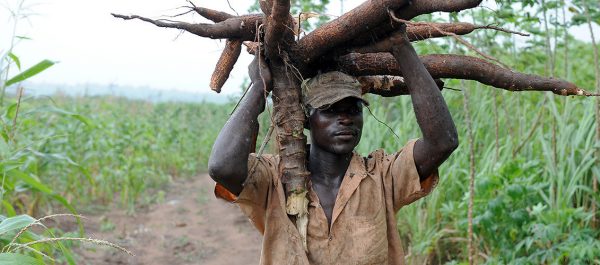
Approximately 1,000 cassava farmers and processors from the South-West region have participated in a training program focused on Good Agronomic Practices to enhance their skills in cassava farming and processing. This initiative was announced by Adeyemi Olojede, the Director of Tuber Crops Research at the National Root Crops Research Institute (NRCRI), during the program’s official launch at Fashola Farm in Oyo town, Oyo State.
Olojede noted that the program, organized by the African Agricultural Technology Foundation (AATF), aims to reach over 6,000 farmers, with particular emphasis on empowering women and youths. He expressed optimism that the initiative would significantly improve cassava farming and processing in Nigeria, equipping participants with essential skills to enhance their livelihoods through better production methods and increased value creation.
“This weeklong training, facilitated by the NRCRI, kicked off with the first batch of 1,000 participants, comprising farmers and processors,” he stated. The program is supported by the German Federal Ministry for Economic Cooperation and Development and implemented by Deutsche Gesellschaft für Internationale Zusammenarbeit GmbH in collaboration with AATF, Agridrive Ltd., and Clayuca Corporation.
Olojede revealed that this training marks the initial phase of a series expected to unfold over three years, with plans to train 1,000 participants in 2024, 2,000 in 2025, and 3,000 in 2026. The program will also include training for 1,000 processors, mainly women from Oyo and Ogun states, focusing on enhancing value addition in cassava processing.
Kehinde Jimoh, AATF’s Programme Officer for Agribusiness, emphasized that the initiative is part of the foundation’s broader commitment to boost the productivity of cassava farmers and processors. He highlighted that the training aims to empower participants with best agronomic practices and value addition strategies, which are expected to lead to significant improvements in their livelihoods and cassava productivity.
Jimoh also noted the importance of this training in not only boosting cassava production but also enhancing value addition, providing farmers with alternative income streams.


